
Competing With Corporate Groups for Veterinary Hires in 2026

Key takeaways
- Make the real job easy to inspect: show the schedule, introduce the support team, explain decision paths, and let another doctor describe how the practice actually runs.
- Compensation must be competitive and affordable: dated salary figures provide context, not a national floor or a prescribed offer for one companion-animal practice.
- Schedule integrity beats a polished promise: the hours, appointment pace, lunch coverage, call responsibility, and time off described in recruiting must survive contact with a normal week.
- Support capacity is part of the offer: candidates need to see who performs which work, whether technician skills are used, and where coverage becomes fragile.
- Wellbeing is an operating question: an assistance program or statement means little when appointment load, call, and absence coverage contradict it.
- Persistent vacancies change ownership risk: when uncovered medicine keeps returning to the owner, the hiring problem can become a transferability and succession problem.
The candidate liked the hospital. Clean treatment area.
New dental suite. A calm team moving through a busy afternoon without the practiced smiles of a tour.
Then she stopped beside a technician and asked who covered lunch when a doctor called out.
I watched the owner go still. The technician answered honestly: usually the owner, unless the schedule was already too full to move.
That unscripted sentence carried more weight than the recruiting deck. It told the candidate who absorbed a broken promise and how quickly her protected day could disappear.
An independent veterinary practice competes for hires in 2026 by making the real job easier to verify: competitive, affordable pay; a schedule the team protects; useful technician support; owner access; and clinical decisions the candidate can observe, not merely read in an offer.
The edge is not independence by itself. It is a specific role that holds up under questions from somebody who does not own the practice.
What are independent practice owners really competing against for veterinary hires in 2026?
Owners are competing against clarity as much as scale. A larger employer may present recognizable benefits, standardized systems, recruiting reach, and a polished offer quickly.
The independent practice must make its own compensation, schedule, support, decision access, and daily clinical experience equally legible without claiming every employer operates alike.
I would never tell an owner to caricature the other option. Some larger employers build excellent teams.
Some independent practices make promises their schedules cannot keep.
The candidate is comparing this job with that job, not choosing between moral categories.
Scale is visible.
A 2025 peer-reviewed Frontiers SWOT analysis offers a useful population signal. Among associates in the study, 55.1% preferred independent practice, although about 70% of respondents worked in larger-group settings.
That does not prove a candidate will choose your practice. It says the independent model can be attractive when the job underneath it deserves the preference.
The same analysis reported independent-owner satisfaction of 84% with the job, 76% with lifestyle, and 75% with compensation. Those are owner reports, not associate recruiting guarantees.
Current hiring evidence also resists easy slogans. AVMA reported that nearly 60% of 2025 graduating seniors had secured full-time employment before graduation, while the share entering full-time work had declined each year since 2022.
The market may be softer at the edges. A strong candidate can still choose.
That is the comparison.
That is why I start with the job’s evidence, then use our associate veterinarian recruiting guide for the complete sourcing, interview, and onboarding workflow.
Can an independent practice match veterinarian pay without starting a salary auction in 2026?
Set compensation from current market context, the candidate’s role, internal fairness, and the practice’s affordable capacity, then explain the whole package clearly.
Do not treat one national average as a required offer or keep bidding against an unseen number after the schedule, support, or economics stop making sense.
Total compensation means the full economic package: guaranteed pay, variable pay, benefits, paid time, professional support, and the conditions attached to each part.
AVMA’s October 2025 update reported an average $140,000 real starting salary in 2024 dollars for companion-animal graduates entering full-time employment. It was an average for that population, not a 2026 national floor.
The AVMA 2025 economic report used a different population and period. Companion-animal-exclusive associates reported a $146,196 mean and $133,000 median in 2023 income reported during 2024.
Mean and median are not interchangeable. The mean averages every response; the median is the middle response after values are ordered.
I would use both datasets to frame a conversation, never to prescribe one offer. Geography, experience, schedule, production opportunity, benefits, and support all change the actual role.
The number is one piece.
Debt belongs in the candidate’s context too. Today’s Veterinary Business, reporting AVMA’s 2026 economic data, said nearly 40% of graduating veterinarians carried $200,000 or more in debt.
An owner does not need to solve every loan. The offer does need to be plain enough that the candidate can judge predictable income, downside, and timing.
Affordability matters because demand has been uneven. AVMA reported client visits fell about 3% in 2025 while revenue grew about 2.5%, with 81% of veterinarians seeing greater client cost sensitivity.
Only 32% reported improved profitability in that survey. I would model the hire against realistic demand and doctor capacity before turning urgency into a permanent cost structure.
Money cannot hide fragility.
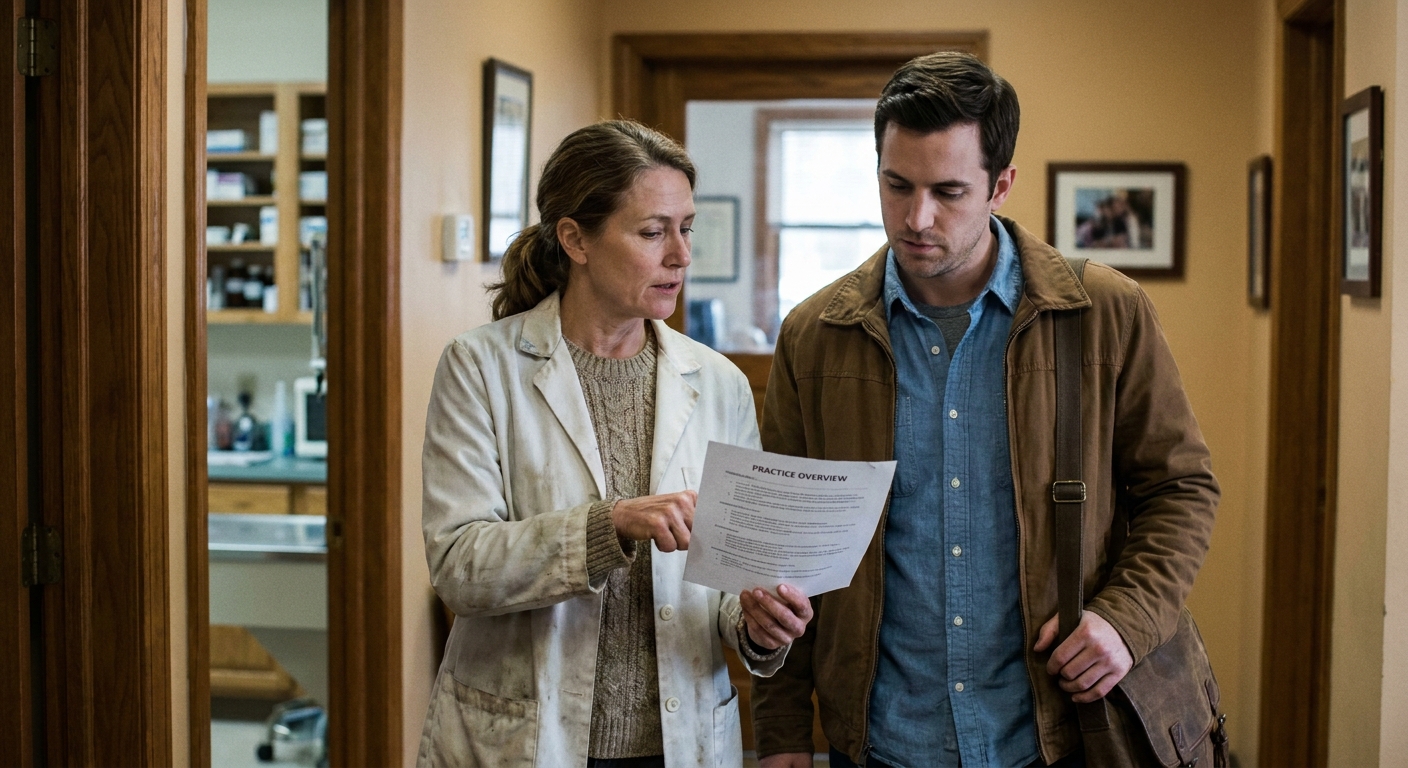
What should a candidate be able to verify during a veterinary interview in 2026?
Give the candidate interview proof: a representative schedule, private conversations with another doctor and support staff, a walk through real workflow, and clear examples of how callouts, equipment requests, clinical disagreements, and time off are handled.
The promise is credible when different people describe the same role without matching scripts.
Interview proof is something the candidate can directly observe or verify instead of accepting only the owner’s description.
I ask owners to separate proof from performance. A polished tour is performance; last week’s schedule is proof.
Proof has edges.
Let the candidate see where urgent cases land. Show which blocks are protected, how appointments are added, and who can say no when the day is full.
Then step out.
Another doctor should be free to answer how equipment gets approved, whether case discussions are useful, and what happened the last time coverage collapsed.
The support team should explain its own work. That answer tells a candidate more than a slide promising “great technicians.”
Teams know.
| Candidate question | Large-employer signal | Independent-practice proof |
|---|---|---|
| What will my day look like? | Standard schedule | Recent schedule, actual pace |
| Who helps me? | Defined support roles | Meet the team, map the work |
| Who can change this? | Escalation path | Direct decision access |
| Can I practice my way? | Clinical standards | Real case examples |
| What happens on a callout? | Coverage policy | Last callout, honest answer |
| Is time off usable? | Written benefit | Coverage on the calendar |
The middle column is not a promise about every larger employer. It shows the kinds of signals scale may make easier to present.
Your column must be observable. If it is not, fix the role before polishing the language.
How does schedule integrity change a veterinary offer in 2026?
Schedule integrity means delivering the hours, appointment pace, coverage, lunch protection, and time off described during recruiting.
Show the candidate a normal week and an ugly one, then explain who absorbs callouts and overflow. A flexible promise is worthless when the operating system routinely overrides it.
I have seen owners describe a compressed clinical week while quietly depending on an extra day whenever another doctor is away. Candidates eventually find that arithmetic.
The harder question is who carries the variability.
Real weeks are messier.
If every absence expands the associate’s day, the schedule is not protected. It is merely optimistic.
On-call deserves its own plain answer. A 2022 Galaxy Vets vendor survey collected 1,942 responses and reported that almost 1 in 3 respondents had to be available at least 5 weeknights or weekends per month.
The same dated vendor survey associated on-call duty with higher burnout regardless of frequency. I would not generalize that result to every doctor, but I would never hide the call reality.
Show the written rotation and a recent period. Explain what counts as available, how often the phone rings, whether a doctor comes in, and what happens after a difficult night.
Time off has a similar test. A benefit is usable only when the calendar and coverage make it possible.
That first tour question about lunch was really a schedule-integrity test. The technician understood it before the owner did.

How can support-team capacity become a recruiting advantage in 2026?
Support capacity helps recruiting when candidates can see trained people consistently performing appropriate work, managers removing operational friction, and coverage surviving normal absences.
Technician leverage is not a claimed ratio; it is the reliable transfer of suitable tasks so a veterinarian can spend more time on doctor-level care.
Technician leverage means the useful clinical work credentialed technicians and trained support staff can reliably perform, leaving the veterinarian focused on doctor-level care.
The word reliably matters. One exceptional technician carrying an entire treatment area is a person, not a system.
Look underneath.
A 2024 Frontiers study surveyed 82 US veterinary technician educators and administrators about the 2018-2022 period. 43% reported declining student enrollment.
The pipeline problem was not only seats. 57% cited concern that credentialing would not change job duties, while 53% cited concern that credentials would not substantially increase pay.
Those findings should change the owner’s interview. Do not promise support without explaining how credentials, training, and job duties are actually used.
Management capacity matters too. AVMA’s February 2024 coverage of a VHMA survey included 275 practices and 3,289 nonveterinarian staff.
From 2021 to that 2023 survey, reported practice-manager median salary rose from $60,000 to $65,000, while hospital-administrator median salary rose from $75,000 to $85,000.
Those dated figures are not a current pay prescription. They show that support leadership carries real cost and should not be treated as invisible overhead when the owner builds the doctor role.
During the tour, point to decisions the manager owns. Let technicians describe the work they perform and where they need a doctor.
If the candidate hears “we all pitch in” but sees the veterinarian doing every task, the recruiting message has already failed.
How should an owner prove clinical autonomy and decision access in 2026?
Define the boundaries, then demonstrate them with recent decisions. Clinical autonomy is medically appropriate judgment within the practice’s standards and resources; decision access is the doctor’s ability to reach whoever can approve a staffing, scheduling, equipment, or operating change without disappearing into an undefined chain.
Owners sometimes sell autonomy as “nobody tells you what to do.” That is not a clinical model. It is an absence of explanation.
Autonomy needs boundaries.
Clinical autonomy means room to make medically appropriate case decisions within standards, resources, and legal duties.
Use actual cases. Who chooses diagnostics, referral, treatment approach, and appointment length when the medical facts do not fit the template?
Then explain the constraints without apology. Formularies, safety rules, team capacity, and equipment limits exist in independent practices too.
Decision access means the doctor can reach the person able to approve a meaningful change.
Local ownership can shorten that distance. It does not guarantee the answer will be yes.
I would give the candidate one example of a request approved, one modified, and one declined. Explain who decided, how long it took, and what evidence mattered.
Case ownership matters in the same practical way. Can the associate follow a complex case, call the client, and adjust the plan, or does the schedule scatter continuity across whoever is open?
The candidate should ask another doctor. When that answer matches the owner’s description in substance, the role starts to feel real.
Call it plainly.
What does credible veterinary wellbeing support look like in 2026?
Credible wellbeing support begins with workload, coverage, psychological safety, and a schedule that can absorb ordinary disruption. An employee assistance program can help, but it cannot compensate for chronic overload.
Candidates should hear how concerns are raised, discussed, acted upon, and revisited after the immediate pressure passes.
An employee assistance program, or EAP, is a confidential benefit connecting employees with counseling and practical support.
Merck Animal Health’s Fourth Veterinary Wellbeing Study used 2023 survey data from 4,636 veterinarians and 2,271 team members. It reported EAP availability at 38% of clinics, up from 31% in 2021 and 27% in 2019.
Only 36% of veterinary teams in that study discussed wellbeing or mental health in team meetings.
I would not turn those percentages into a checklist. Buying an EAP does not prove people have time, privacy, trust, or coverage to use it.
Workload wins.
Ask what happens after someone says the pace is unsafe. Who reviews the schedule?
What changes tomorrow, and who follows up next week?
Appreciation belongs in the operating system too. AVMA’s February 2025 account of AAHA retention research covered 2,713 veterinary professionals and ranked fair compensation first among attrition-reducing factors, followed by appreciation and career development.
Practices with 90% retention in the reported sample shared a habit: they surveyed staff regularly and used the feedback. That is an association in the sample, not a guarantee that one survey causes retention.
The useful recruiting proof is not “we listen.” Show one concern the team raised, the decision that followed, and what remained unresolved.
Candor has texture. Candidates can hear it.
How should an owner present career growth without making a vague promise in 2026?
Tie growth to real work, named support, decision dates, and resources the practice can provide. Describe the cases, skills, leadership responsibilities, continuing education, and feedback cadence available now.
Do not borrow prestige from an undefined future title or let mentorship language substitute for protected time and accountable people.
Career growth can mean deeper clinical capability, leadership, a new service, management responsibility, or stronger communication. It does not need to mean ownership.
That distinction matters. The owner should not promise a path that belongs in a different conversation merely to make today’s role sound larger.
I ask for nouns and dates. Which procedure?
Which mentor? Which cases?
What budget? When will the first review happen?
Specifics beat aspiration.
The AAHA retention findings make appreciation and career development relevant, but they do not tell one owner exactly what to offer. The candidate’s goals should shape the plan.
Profession-wide sentiment is mixed enough to require listening. Today’s Veterinary Business reported from 2026 AVMA data that 3 in 4 veterinarians were satisfied with their job, lifestyle, compensation, and profession.
The same coverage said more than 9% had considered leaving the profession for reasons other than retirement. Satisfaction and exit risk can exist in the same workforce.
AVMA’s 2025 economic report found 8.6% of veterinarians considering departure for nonretirement reasons in 2024. It also reported only 51.9% satisfied or very satisfied with the profession as a whole.
Different editions and reporting frames should not be collapsed into one benchmark. They do support a straightforward owner question: what would make this particular doctor want to build here?
Write the answer together. Then put the first evidence review on the calendar before the candidate signs.
What should owners and candidates ask each other during veterinary interviews in 2026?
Owners should ask what the candidate needs to verify, which trade-offs matter, and what has broken trust in prior roles.
Candidates should be invited to test compensation clarity, schedule integrity, support, autonomy, access, and growth. The owner should answer directly, including where the practice is still improving.
I would rather hear one uncomfortable question during an interview than discover much later that both sides protected the wrong impression.
Ask the candidate to rank the trade-offs. More pay, a shorter week, specific cases, stronger support, predictable call, direct owner access, or formal development may not carry equal weight.
Then ask for evidence standards. What would the candidate need to see or hear to believe the schedule is protected?
Let the silence work.
The candidate should question the team without the owner directing every answer. Who covers lunch?
What happens when the last appointment runs late? How often does equipment approval stall?
Owners need questions too. How does the doctor handle disagreement, ask for help, communicate a missed handoff, and respond when a preferred plan meets a real resource constraint?
This is not a trial designed to catch somebody. It is a search for compatible operating habits.
Fair compensation still anchors the conversation. So do appreciation and development, which the reported AAHA research placed immediately behind pay.
The best interview is specific enough that either side can walk away before a fragile promise becomes an expensive relationship.
When does a veterinary hiring problem become an ownership problem in 2026?
A hiring problem becomes an ownership problem when vacancies repeatedly force the owner to absorb medicine, relationships, decisions, or revenue that no system can carry without them.
One difficult search is not a verdict. Persistent owner dependence can weaken continuity and narrow succession options even while the practice remains busy.
I look for the return of old work. Did the owner give up clinical days, then take them back because coverage failed?
Did a promised leadership role vanish because every decision still lands in the owner’s inbox? Did time away become possible only when another doctor cancelled theirs?
That loop is expensive.
That is owner dependence: performance relying on the owner’s continuing labor or judgment instead of a durable team and operating system.
An owner in that position has paired questions. Can the role be rebuilt honestly, and how does the dependence affect the future?
Our guide to when to sell a veterinary practice helps frame the timing question. The broader guide to selling a veterinary practice explains the sale path without turning one vacancy into a predetermined decision.
Selling stays subordinate here. The first job is to diagnose the role, compensation, schedule, support, and interview evidence without self-protection.
The future stays optional.
If the pattern persists, our Elite Selling System hand-selects and vets every buyer invited to bid, the way a doorman with a velvet rope admits only the right people before a private competitive window opens.
That system does not repair a recruiting promise. It gives an owner a disciplined option when continued dependence is no longer the life they want.
What should an independent practice owner do next about veterinary hiring in 2026?
Audit the job before rewriting the advertisement: compare compensation with dated context, test affordability, inspect recent schedules, map support work, document decision paths, and let the team challenge the recruiting story.
Then invite candidates to verify the repaired role instead of asking them to trust a more polished description.
Start with last week, not aspiration. Put the actual doctor schedule beside the offer and mark every place the owner or team rescued it.
Start there.
Map support next. Name the work a credentialed technician performs, what other trained staff handle, and what returns to the doctor when somebody is away.
Then follow a recent decision from request to answer. The elapsed time matters as much as the outcome.
Rebuild compensation only after those facts are visible. A higher number can attract attention, but it cannot make a contradictory role hold together.
Invite one trusted team member to challenge every line of the recruiting story. If “protected lunch” produces a laugh, you found the work.
Some owners will repair the system and hire well. Others will see that the practice keeps asking for a version of ownership they no longer want.
If you need to compare those futures, a free, confidential practice value estimate can show what the ownership option looks like before urgency makes the choice for you.
I still think about that technician’s answer. It was not polished, but it was useful, and useful truth is where the better offer begins.
Frequently asked questions for practice owners in 2026
Can an independent veterinary practice compete with a larger employer for hires in 2026?
Yes, when the practice offers competitive, affordable compensation and proves the job it describes. Candidates can verify schedule integrity, owner access, clinical autonomy, support-team capacity, mentorship, and case ownership during the interview.
An independent label alone does not create those advantages; the specific role must demonstrate them.
Should an independent practice match the highest veterinarian salary in 2026?
Not blindly. Pay must be credible for the market and fair inside the practice, but the owner should model the complete package against realistic demand, doctor capacity, and support costs.
A number the practice cannot sustain will not create a durable role, especially if the schedule or staffing promise fails.
What does schedule integrity mean for a veterinary hire in 2026?
Schedule integrity means the practice can deliver the hours, appointment pace, coverage, lunch protection, and time off described during recruiting.
A candidate should see a real schedule and hear how absences are handled. The owner’s promise loses value when the team describes a different daily operating reality.
How can an owner prove clinical autonomy during a veterinary interview in 2026?
Use real examples. Explain who decides case approach, referral, diagnostics, equipment requests, and appointment length, then let the candidate ask another doctor how those decisions work.
Clinical autonomy is not the absence of standards; it is medically appropriate judgment within clear resources, duties, and practice expectations.
Does an employee assistance program prove veterinary wellbeing support in 2026?
No. An employee assistance program can be useful, but it is one resource, not proof that the role is sustainable.
The stronger evidence is whether the practice protects coverage, discusses wellbeing without theater, responds to workload concerns, and keeps the on-call and appointment reality consistent with its recruiting language.
Why does technician capacity matter to veterinarian recruiting in 2026?
Technician capacity shapes what the doctor actually does all day. Reliable credentialed and trained support can protect doctor-level time, improve workflow, and make the promised caseload believable.
The owner should show who performs which tasks and where coverage breaks, without claiming a staffing ratio the practice cannot consistently maintain.
What should a veterinary candidate be allowed to verify in 2026?
Let the candidate inspect a representative schedule, meet the support team, speak privately with another doctor, and ask how callouts, equipment requests, clinical disagreements, and time off are handled.
Interview proof works because people besides the owner can describe the same job without being coached toward identical wording.
When does a chronic veterinary hiring problem become succession risk in 2026?
It becomes succession risk when the practice repeatedly needs the owner to absorb uncovered medicine, relationships, decisions, or revenue. One difficult search does not decide the future.
A recurring pattern can make earnings and continuity depend on the owner, so hiring strategy and ownership options should be evaluated together.
Sources
Veterinary hiring, compensation, and profession data
- American Veterinary Medical Association. “Inflation Continues to Dampen Gains in Veterinarian Salaries, Fewer New Grads Entering Full-Time Employment.” October 15, 2025. avma.org
- American Veterinary Medical Association. “2025 Report on the Economic State of the Veterinary Profession.” ebusiness.avma.org
- American Veterinary Medical Association. “AAHA’s Second Retention Study Emphasizes Surveying Employees to Understand Workplace Needs, Desires.” February 20, 2025. avma.org
- American Veterinary Medical Association. “Veterinarians Report Increasing Price Sensitivity, Decreasing Visits.” February 13, 2026. avma.org
- Today’s Veterinary Business. “US Veterinary Industry Grows Amid Rising Challenges.” March 19, 2026. todaysveterinarybusiness.com
Independent-practice and support-team research
- Frontiers in Veterinary Science. “Making the Case for a Resurgent U.S. Independent Veterinary Practice Segment: A SWOT Analysis.” May 13, 2025. frontiersin.org
- Frontiers in Veterinary Science. “Trends in Enrollment, Retention, and Graduation of United States Veterinary Technicians/Nurses Schools.” 2024. pmc.ncbi.nlm.nih.gov
- American Veterinary Medical Association. “Survey Results Show Overall Salary Increases for Veterinary Staff Members.” February 26, 2024. avma.org
Wellbeing and workload evidence
- Merck Animal Health. “Fourth Veterinary Wellbeing Study Indicates Progress in Addressing Mental Health Challenges Among Veterinary Teams.” January 15, 2024. merck-animal-health-usa.com
- Galaxy Vets. “The Emotional Toll of Financial Stress, Work Environment, and Euthanasia.” 2022 vendor survey. galaxyvets.com

Melani Seymour, co-founder of Transitions Elite, helps veterinary practice owners take action now to maximize value and secure their future.
With over 15 years of experience guiding thousands of owners, she knows exactly what it takes to achieve the best outcome.