
How to Keep Your Associate Veterinarians From Leaving in 2026

Key takeaways
- Fair compensation comes first: AAHA’s retention research found it was the strongest factor reducing attrition, ahead of appreciation and career development.
- Listening only matters when the owner acts: practices with 90% retention shared a habit of surveying staff regularly and using the feedback.
- Use turnover data as a warning light, not an excuse: companion-animal-exclusive practices averaged 19.4% team turnover in 2022, but the useful comparison is your own pattern of departures and unresolved concerns.
- Pay expectations have moved: the inflation-adjusted compensation gap between new graduates and all veterinarians narrowed from 93% in 2001 to 19% in 2024.
- Wellbeing has to show up in the workday: an assistance benefit helps, but chronic overload, unusable time off, and concerns that disappear into silence will still send good doctors looking.
- A stable doctor team protects transferability: for a $2M+ companion-animal general practice, keeping associates supports the earnings story a future buyer must believe can survive the owner’s exit.
Most owner conversations about a departing associate start after the story has already gone stale.
When I sit down with them, I hear the same phrase: “She suddenly disengaged.”
So I ask what changed; usually, nothing about it was sudden, because the schedule had been running hot, a compensation review kept slipping, and every concern met some version of “after things calm down.”
Then the notice arrives.
By that point, the owner is not negotiating against another offer; she is negotiating against a long accumulation of evidence that nothing will change.
To keep associate veterinarians from leaving in 2026, pay fairly, ask what is fraying, act on answers, protect schedules from chronic overload, and offer a credible growth path; AAHA’s retention research puts fair compensation first.
High-retention practices survey regularly and act.
Why do associate veterinarians leave a practice in 2026?
Associates leave when several parts of the job stop working together: pay feels unfair, effort goes unseen, growth stalls, or the schedule takes more than it gives; one bad week rarely explains resignation.
Repeated concerns with no credible response raise risk; that pattern is the warning.
AAHA’s study gives owners the order.
Fair compensation was the strongest factor reducing attrition, followed by appreciation for the work and career development.
That order matters; I’ve watched owners reach first for a team lunch, another wellness app, or a warmer thank-you note because each is easier than reopening compensation or changing the schedule.
Appreciation cannot replace fair pay.
The same distinction applies to growth: the next chapter needs evidence, not a grand promise.
A doctor may want more surgery, leadership responsibility, a clinical niche, or a future ownership conversation.
She needs to know that path exists and that someone has agreed to help her reach it.
Some departures are not preventable.
A spouse relocates, family needs change, a doctor wants a different kind of medicine, or the fit was wrong from the start.
The owner’s job is not to prevent every exit; it is to stop losing good doctors for reasons the practice knew about and left untouched.
Is fair compensation really the first fix?
AAHA’s retention work ranked fair compensation as the greatest attrition-reducing factor; new-graduate pay is closer to pay across all veterinarians, and heavy educational debt makes predictability matter, so review internal fairness, competitiveness, and formula clarity.
Start with the pay formula.
When I walk an owner through today’s pay context, one number changes the conversation.
AVMA reported that the inflation-adjusted gap between new-graduate and all-veterinarian compensation narrowed from 93% in 2001 to 19% in 2024.
Salary compression is the narrowing gap between new-graduate pay and pay across all veterinarians; it does not mean identical packages, only that today’s plan cannot rest on what a doctor accepted years ago.
Debt changes the room quickly.
AVMA reported that 40% of 2025 graduates owed $200,000 or more.
An associate managing that obligation will notice a delayed review, a mysterious production calculation, or a new hire brought in above her pay.
Silence invites the doctor to write her own explanation, and it is rarely flattering.
Start with these questions:
- Is the pay formula understandable? The associate should be able to explain how compensation is calculated and when it is reviewed.
- Is internal equity defensible? Experience, schedule, production, and responsibilities may justify differences, but the owner should be able to articulate them without improvising.
- Does the total job match the pay? A competitive salary loses its shine when the doctor is carrying chronic overtime, unstable weekends, or unsupported cases.
This is not a hiring budget.
Owners who need the full compensation context can use our separate guide to the cost to hire an associate veterinarian.

How should an owner ask what would make an associate stay?
Make the conversation routine, private, and specific: ask what the doctor wants, what drains energy, what feels unfair, and which promises stalled.
Record the next action and close the loop, because an unanswered survey teaches that speaking up creates paperwork, not improvement.
AAHA surveyed 2,713 veterinary professionals.
Practices reporting 90% retention shared one habit: they surveyed staff regularly and used the feedback they received.
I have a rule here: no concern gets to vanish into polite meeting notes.
The second half of AAHA’s finding is the whole game because those practices used the feedback.
An owner cannot grant every request, but she must close the loop with one of these honest answers: yes and when, no and why, or not yet and what would have to change.
Ask what matters:
- Which part of your week is hardest to repeat? This surfaces schedule friction more clearly than “How are things?”
- What have you asked us to change that still feels stuck? That gives old promises nowhere to hide.
- What skill or responsibility do you want next? The answer turns development into a plan instead of a compliment.
- What would make you take a call from another practice? Asked calmly, this exposes the offer your job is currently making to competitors.
Call these stay conversations if the team needs a label, but do not turn them into loyalty tests.
The owner should listen for patterns across doctors and support staff, because an associate’s problem may begin elsewhere.
A doctor with inadequate technician help can look slow on paper while the real bottleneck sits in support capacity.
What does career development look like after the associate is hired?
Career development means the associate sees a real, funded, scheduled next step in clinical work, leadership, mentoring, a new service, or ownership; the owner names the milestone, support, and review date.
Make future growth visible, not vague, from the start.
When I revisit a hire with an owner, I ask what the associate is building toward now.
Recruiting articles talk about mentorship because candidates want it; keeping that doctor requires continued development after the first months stop feeling new.
Keep the plan specific and modest.
A surgeon-minded associate may need protected case selection and a clear escalation path.
A future medical director may need responsibility for one operating problem before being handed a title.
Progress needs proof.
That means budget approval, calendar time, case access, and named responsibility.
Growth is not endless addition.
Giving the strongest associate every difficult case, new-doctor question, and schedule rescue is not development; it is an unpriced second job.
If the practice is still designing recruiting and onboarding, our guide on how to hire an associate veterinarian owns that part of the decision.
Here, the test is simpler: can the doctor already on payroll describe what she is building toward?
What does a retention-friendly workload look like?
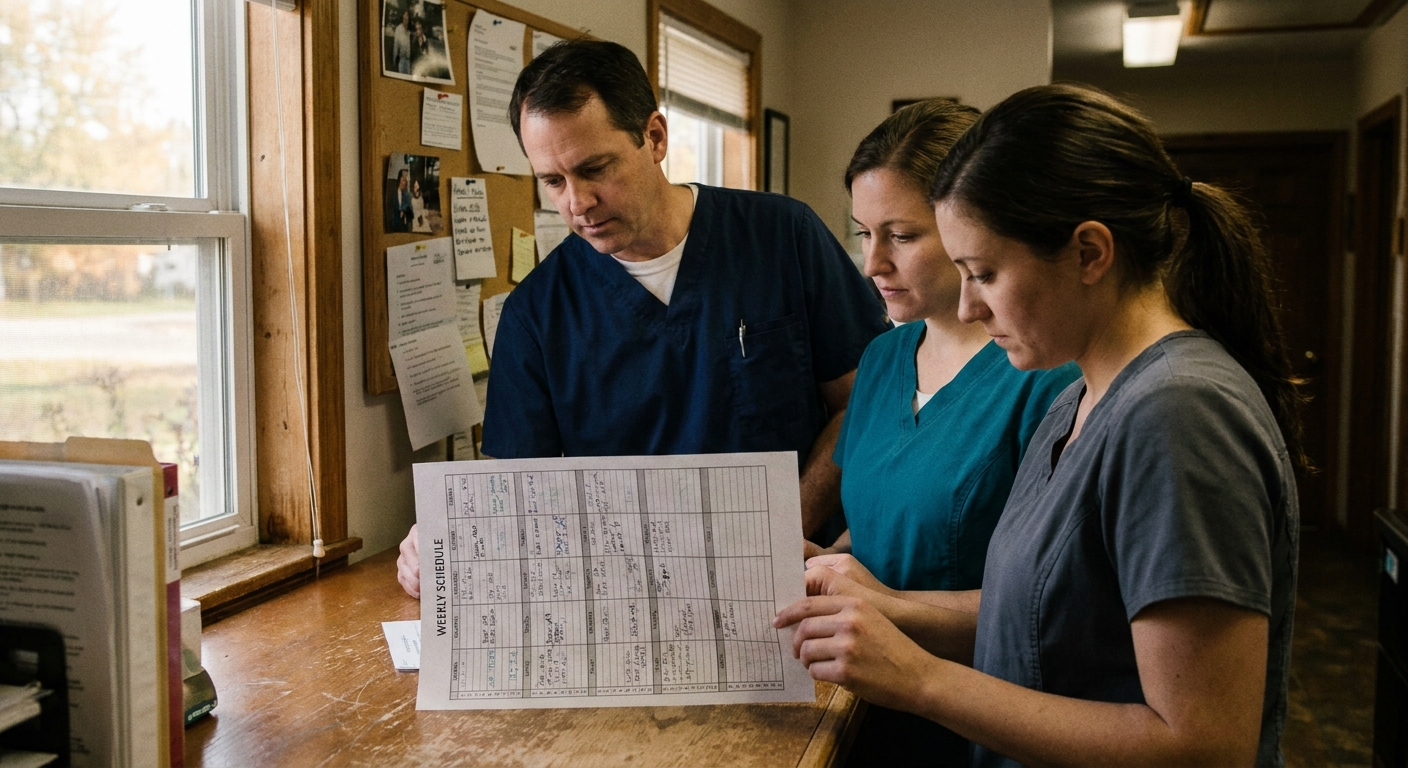
A sustainable workload has predictable, defended boundaries: usable time off, clear weekend coverage, enough support, help on difficult medicine, and a way to raise overload before it becomes normal; wellbeing benefits cannot repair permanent strain.
Design the whole schedule first.
Benefits are not where I start, but Merck’s Fourth Veterinary Wellbeing Study found that 38% of clinics offered employee assistance programs, up from 31% in 2021 and 27% in 2019.
An employee assistance program is a confidential benefit connecting employees with counseling, mental-health resources, and practical support.
The same study found only 36% of veterinary teams discussed wellbeing or mental health in team meetings.
A benefit nobody trusts, understands, or has time to use is a logo on a portal.
The operational questions are more revealing:
- Can doctors take the time off already promised to them?
- Does the schedule absorb a sick day without punishing everyone who remains?
- Are difficult cases debriefed, or does the next appointment simply start?
- Can an associate ask for help without looking weak or slowing a production score?
International research adds context.
It is not a US benchmark.
A 2025 study of 724 veterinarians across 7 European countries found that an average of 24.4% reported a diagnosed mental illness.
That finding reminds owners that workplace mental health belongs in serious operating conversations.
Older surveys reveal another trap.
In a 2022 survey, almost every 3rd respondent had to be available for at least 5 weeknights or weekends per month.
On-call staff reported higher burnout regardless of frequency.
Support-team strain matters too.
A 2024 study covering 2018 to 2022 found 43% of surveyed veterinary technician educators and administrators reported lower enrollment.
In the same research, 64% attributed graduation declines to student mental-health challenges.
That predicts nothing locally.
It does mean an owner should not try to keep associates by assuming technicians can absorb unlimited additional load.
What should you measure instead of relying on a gut feeling?
Track departures, tenure, recurring concerns, schedule friction, missed development commitments, and action closure; use published turnover only as context.
A below-average practice can still lose the associate whose departure most harms clients, the team, and the owner’s workload; your own pattern matters most.
The turnover rate is the share of team members who leave during a defined period, usually a year.
AVMA’s owners survey reported 19.4% average team turnover in companion-animal-exclusive practices in 2022.
Because that figure is team-wide and historical, it is not a healthy target for associate doctors.
When I review a team problem carefully, I keep profession-wide numbers firmly in their lane; the 2025 State of the Profession report gives us this intent snapshot:
| Profession-level intent in 2024 | Share of veterinarians |
|---|---|
| Considering leaving the profession for reasons other than retirement | 8.6% |
| Had considered leaving but decided to stay | 35.6% |
| Had never considered leaving | 55.8% |
These figures describe profession-level intent, not a practice turnover target or forecast.
They still warn against both extremes: assuming every associate is flight-risky, or assuming silence means everyone is fine.
Use a small owner dashboard instead:
| Signal | What to record | What the owner should do |
|---|---|---|
| Voluntary departures | Role, tenure, stated reason, unresolved concerns | Look for repeat causes instead of writing each exit off as personal |
| Stay-conversation themes | Pay, schedule, support, growth, leadership | Assign an owner and due date to every accepted action |
| Schedule strain | Missed breaks, overtime, unusable time off, coverage gaps | Fix the recurring design problem, not only the worst week |
| Development promises | Training, cases, leadership steps, review dates | Show progress or reset the promise openly |
| Closing the loop | Request, decision, response date | Report back even when the answer is no |
No national benchmark can tell you whether a specific associate has stopped believing the practice will change; your own follow-through can.
When is an associate’s departure structural rather than preventable?
A departure is structural when life or career no longer fits the role through relocation, family needs, a different clinical path, or an incompatible long-term goal.
Test solvable workplace causes without demanding a defense, because a respectful exit protects the team and clients; leave room for dignity.
I’ve learned not to turn every resignation into a loyalty test, because loyalty tests suppress candor when the remaining team needs permission to speak plainly.
Ask what the practice could have done differently and allow “nothing” to be a real answer; then preserve a sensible transition, clean case handoffs, a respectful team explanation, and an exit conversation that may reveal a fix for the next doctor.
The broader data is calmer; in 2024, 55.8% of veterinarians said they had never considered leaving the profession, while another 35.6% had considered it and decided to stay.
Today’s Veterinary Business, covering the AVMA’s 2026 economic report, said 3 in 4 veterinarians reported satisfaction with their job, lifestyle, compensation, and the profession; keep that profession-wide context in its lane, because it forecasts nothing locally.
Some doctors stay after a job improves; others stay because a personal season passes, the right manager arrives, or another role opens, which is why keeping a doctor is not control but building a practice worth choosing again.
How does associate turnover affect the value of a veterinary practice?
Repeated departures weaken earnings buyers expect after closing as schedules contract, client relationships break, support staff lose confidence, and owner clinical work rises; a stable associate group cannot guarantee price.
It still makes revenue more transferable; transferability is the point.
For a $2M+ companion-animal general practice, doctor stability is not just an HR concern.
It sits inside the story a future buyer has to believe about next year’s revenue.
Transferability means the practice’s revenue and earnings can continue under new ownership without requiring the selling owner to deliver most of the medicine.
A revolving associate door weakens that confidence even when the current income statement still looks good.
Then comes the deal-side question.
Will the earnings travel?
Owners often wait too long, assuming one resignation will be repaired by the next hire.
Another departure then pushes more production back onto the owner and makes the practice look dependent on the person trying to leave.
Our guide to what happens to veterinary staff when a practice sells explains the people side of a transition.
The valuation question is different: how much of today’s performance can a buyer reasonably expect to inherit?
If the practice can fix pay, workload, and trust, fix them before the earnings story frays.
If the doctor team will not stabilize despite honest changes, learn what the veterinary practice is worth while current earnings are still defensible.
What should an owner do next in 2026?
Start with the associate worth keeping: review compensation, ask what makes the job harder, choose one deliverable fix, set a report-back date, and repeat across the doctor team.
If stability stays doubtful, compare current practice value with another year of drift; choose, act, and report back.
I would not announce a new people program; have the conversation without a launch.
If the answer points to compensation, correct the review process and explain the timing.
If it points to workload, remove one recurring source of strain instead of promising that the next hire will solve everything.
When a transition deserves consideration, our Elite Selling System hand-selects and vets every buyer allowed to bid.
Like a doorman with a velvet rope, it lets in only the right people and creates competition inside that qualified group; a stable doctor team gives those buyers durability worth competing for.
Owners who want the number before choosing can request a free, confidential practice value estimate. It gives the decision a financial boundary without obligating the owner to sell.
Transitions Elite’s fee varies depending on the value of the practice. When the value conversation points toward keeping the practice, the next move is plain: make this a place your best associate can still picture choosing a year from now.
Frequently asked questions
What is the best way to keep associate veterinarians from leaving in 2026?
Start with fair compensation, then make the job sustainable.
Ask associates regularly what is helping or wearing them down, act on the answers, show appreciation in specific ways, and give each doctor a credible path to grow.
AAHA’s retention research put fair compensation first and regular staff feedback among the habits of high-retention practices.
Is higher pay enough to stop an associate veterinarian from leaving?
No. Pay that feels unfair can push a doctor out, so compensation is the first repair.
Once pay is credible, appreciation, career development, schedule control, useful support, and trust determine whether the associate can picture staying.
A raise cannot compensate forever for chronic overload or ignored concerns.
How often should I ask associates what would make them stay?
Ask regularly enough that the conversation is ordinary, not an emergency triggered by a resignation.
Published research does not set one universal frequency.
A short recurring check-in works when the owner records the concern, names the next action, and reports back, even when the answer is that a requested change is not possible.
What is a normal veterinary team turnover rate?
AVMA’s Veterinary Practice Owners Survey reported average 2022 turnover of 19.4% in companion-animal-exclusive practices.
Treat that as a dated team-wide benchmark, not a target for associate doctors or a verdict on one practice.
Track your own departures, tenure, and stated reasons instead of using an industry average to excuse a preventable loss.
How can I tell an associate veterinarian may be preparing to leave?
Watch for a change from engagement to withdrawal: fewer ideas, less interest in future training, repeated schedule friction, concerns raised without resolution, or a doctor who stops asking for help.
None proves an exit is coming.
Treat the pattern as a reason for a private conversation, not surveillance or an accusation.
Does student debt affect associate veterinarian retention?
It can shape how an associate judges pay, predictability, and benefits.
AVMA reported that 40% of 2025 graduates owed $200,000 or more.
Owners do not need to solve every loan, but they should understand that unclear compensation or unstable schedules can feel riskier to a doctor managing a large monthly obligation.
Can employee assistance programs help keep veterinary associates?
They can be one useful layer, but access alone is not a retention plan.
Merck reported that 38% of clinics offered employee assistance programs, while only 36% of veterinary teams discussed wellbeing or mental health in team meetings.
Owners still have to protect confidentiality, make resources easy to use, and fix workplace causes of strain.
Can associate veterinarian turnover reduce practice value?
Yes. Buyers want earnings that can continue after the owner steps back.
Repeated doctor departures can weaken schedules, client continuity, team confidence, and the credibility of future earnings.
A stable associate group does not guarantee a particular price, but it makes the practice’s revenue look more transferable and less dependent on the selling owner.
Sources
Veterinary retention, turnover, and compensation research
- AVMA News. “AAHA’s second retention study emphasizes surveying employees to understand workplace needs, desires.” February 20, 2025. avma.org
- AVMA Blog. “Just one thing: Benchmarking your team’s turnover rate.” May 13, 2024. avma.org
- AVMA. “2025 Report on the Economic State of the Veterinary Profession.” 2025 edition. ebusiness.avma.org
- AVMA News. “Gap shrinks between new graduate, overall veterinary salaries.” November 7, 2024. avma.org
- AVMA Blog. “Chart of the month: Average DVM debt climbing.” January 27, 2026. avma.org
- Today’s Veterinary Business. “US Veterinary Industry Grows Amid Rising Challenges.” March 19, 2026. todaysveterinarybusiness.com
Veterinary wellbeing and workplace context
- Merck Animal Health. “Fourth Veterinary Wellbeing Study.” January 15, 2024. merck-animal-health-usa.com
- Frontiers in Veterinary Science. “A cross-national study on mental health, psychological distress and suicidal ideation among veterinarians.” September 15, 2025. frontiersin.org
- Galaxy Vets. “The emotional toll of financial stress, work environment, and euthanasia.” 2022. galaxyvets.com
- Frontiers in Veterinary Science. “Trends in enrollment, retention, and graduation of United States veterinary technicians/nurses schools.” 2024. pmc.ncbi.nlm.nih.gov

Melani Seymour, co-founder of Transitions Elite, helps veterinary practice owners take action now to maximize value and secure their future.
With over 15 years of experience guiding thousands of owners, she knows exactly what it takes to achieve the best outcome.