
Why Do Some Veterinary Practices Sell for More in 2026?

Key takeaways
- Durable earnings lead the answer: revenue draws attention, but repeatable normalized EBITDA gives buyers something they can defend.
- Transferability changes confidence: results tied tightly to the seller look different from results carried by a stable, distributed team.
- Doctor count is not doctor stability: tenure, workloads, client relationships, and production distribution reveal whether the schedule can hold.
- Top-line growth needs context: pricing, visits, service mix, capacity, and required reinvestment determine the quality beneath revenue.
- Evidence lowers uncertainty: clean financials and operating records help qualified buyers test the same facts without turning paperwork into a promise.
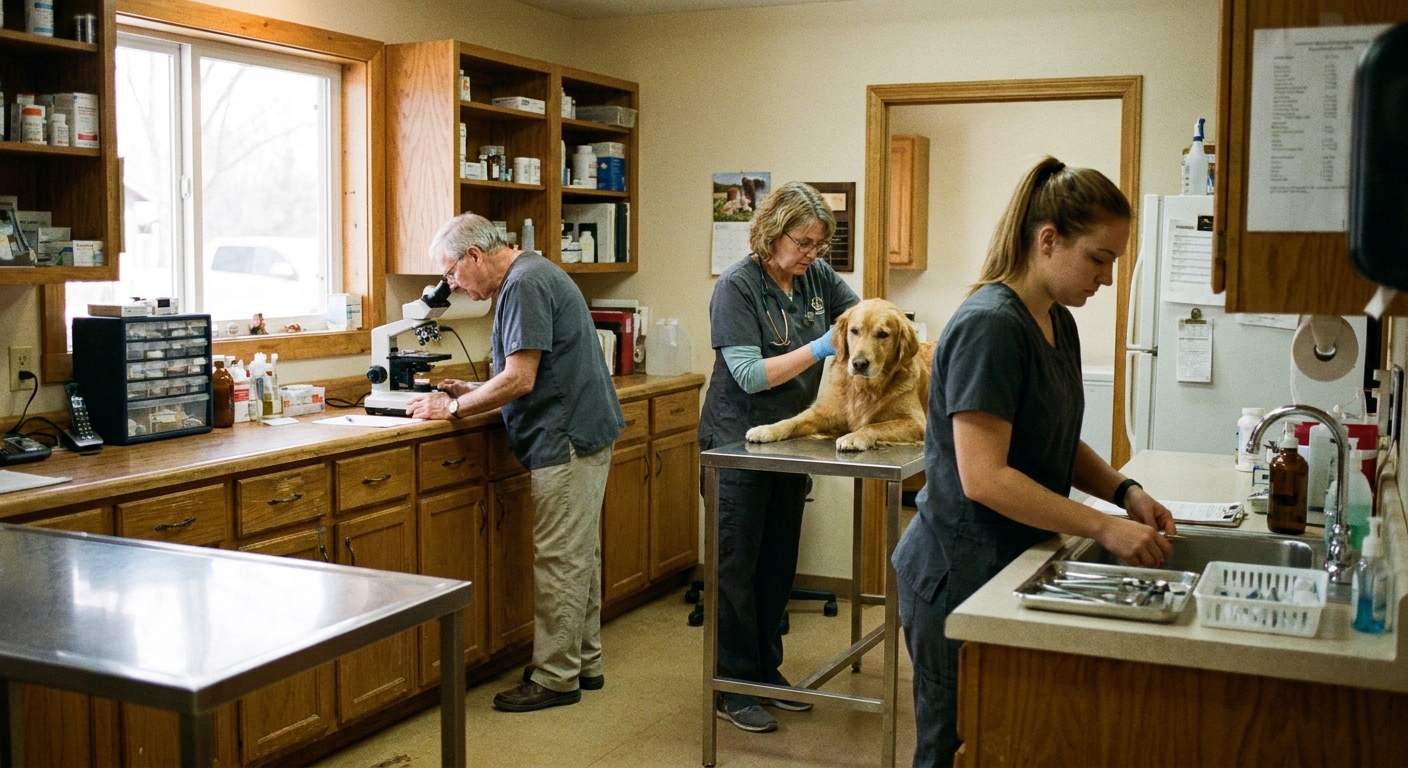
On Monday morning, I take the chair nearest the supply-room door while a veterinary team works through its huddle.
An associate reroutes a same-day case. A technician clears an imaging bottleneck.
The manager adjusts coverage, and the owner barely speaks.
The room keeps moving.
That quiet tells me more than a polished presentation.
That is the clue.
Some veterinary practices sell for more because buyers can see durable normalized earnings that will survive the owner’s departure. Revenue gets attention, but transferability earns confidence.
That confidence is supported by stable doctors and staff, reliable demand, usable capacity, defensible financial adjustments, and clean operating evidence of how the practice actually works every single day.
Why do some veterinary practices sell for more in 2026?
Two companion-animal practices can look similar from the parking lot yet carry different risk.
The one that commands more confidence usually has repeatable normalized earnings, distributed doctor relationships, stable staff, durable demand, usable rooms, and records showing the result can continue after the owner steps back.
I have watched owners focus first on revenue because it is visible and familiar. Buyers look beneath it.
Familiar is not durable.
Not the parking lot.
They ask which earnings repeat, who produces them, whether clients follow the practice or one doctor, and what must be spent to keep the result intact after a sale closes.
That is the difference between scale and earnings that transfer.
The complete veterinary practice valuation method owns the full valuation question. Here, the narrower answer is that a stronger practice gives buyers fewer unsupported assumptions to make.
Published multiple commentary proves why no single shortcut settles the question.
Then the range widens.
QuantPillar’s Q1 2026 guide lists an 8×–14× veterinary EBITDA range and calls size the most predictable general multiple driver across industries. Its broader size table is not a practice-specific promise.
iVET360’s 2024-era operator commentary gives an 8×–13× estimate for high-performing practices and names size, location, profitability, growth potential, client-base quality, practice type, and doctor count as drivers in its list.
Octus reported mid-to-high-single-digit practice-level EBITDA multiples in January 2026. The disagreement is not an invitation to choose the largest range; it is a reason to prove the facts of the actual practice.
Proof wins.
How do normalized EBITDA and earnings quality move buyer confidence in 2026?
Normalized EBITDA is your practice’s earnings before interest, taxes, depreciation, and amortization after defensible adjustments.
Its earnings quality depends on whether those profits repeat, the adjustments withstand scrutiny, and the practice can maintain results without hiding recurring costs or required reinvestment in ordinary operations.
Scrutiny changes the answer.
An add-back is an adjustment for an expense or item that will not continue in the same form after a sale. It is not a label for every cost an owner would prefer to remove.
The detailed veterinary EBITDA add-backs guide covers the complete normalization checklist. For value drivers, the central test is whether the adjusted number describes the practice a buyer will actually inherit.
Owner compensation above a replacement role, a nonrecurring expense, or a personal item may require adjustment. Future doctor coverage, ordinary payroll, equipment upkeep, and repeat operating needs do not disappear because ownership changes.
That distinction creates defensible earnings, not merely a larger spreadsheet number.
A 2019 veterinary trade article stated the principle bluntly: low-profit practices have low values. It separated fixable cost and fee-schedule issues from harder facility, culture, and staff-retention risks.
I find that distinction useful. A dated fee schedule or a visible cost leak may have a clear remedy, while a cramped building or unstable culture can require time, capital, and difficult execution to correct.
Some problems travel.
Earnings quality also asks how the top line was built.
Recurring clinical demand, a resilient service mix, and enough team capacity support a different story from revenue that depends on deferred staffing, unusual owner hours, or postponed reinvestment after closing.
No single adjustment guarantees a higher price. The value comes from a normalized result that survives the next question.
Why do owner dependence and transferability matter in 2026?
Transferability is the practice’s ability to keep serving clients, supporting doctors, and producing earnings after the seller steps back.
Heavy owner dependence can make attractive historical results less valuable because the buyer must judge what remains without the seller’s daily presence.
The most revealing question is not whether the owner works hard. Most do.
It is whether production, decisions, relationships, and problem-solving have become concentrated in one person.
I call that doctor concentration: the share of production, client loyalty, and clinical decisions tied to one veterinarian. When that veterinarian is the seller, a buyer sees a handoff risk inside otherwise strong numbers.
Concentration shows up quietly.
Clients may insist on the owner, associates may defer every difficult case, the manager may lack real authority, or the schedule may collapse when the seller takes a week away.
None of that means the practice cannot sell. It means the buyer needs evidence that care delivery and earnings can continue through a credible transition.
Distributed relationships tell a different story.
Associates have their own client trust. Technicians work at the top of their roles.
The manager can run daily operations, and clinical judgment does not funnel through one doorway.
That is why transferability is not the same as absentee ownership. A seller can remain deeply involved while still building a practice larger than one person.
That is the real handoff.
The guide to deciding when to sell a veterinary practice helps with the timing question. If owner dependence is high, time before a sale can be used to make the handoff more credible.
What makes doctor count and team stability different in 2026?
Doctor count shows how many veterinarians appear on the schedule. Doctor stability asks whether they are likely to stay, can carry sustainable workloads, and hold their own client relationships.
A buyer values continuity, not a roster, because names alone do not prove transferable production.
A roster is easy. Continuity is harder.
Octus’s January 2026 analysis said only approximately 76% of veterinarian demand may be met by 2032. That forecast is context, not a practice-level premium formula.
It explains why replacing a departing doctor cannot be treated as a routine assumption.
AVMA’s October 2025 productivity article, using 2024 practice data, reported an average of 2.76 full-time-equivalent veterinarians and a 2.21:1 medical-staff-to-veterinarian ratio.
Those profession benchmarks are not buyer thresholds. They show how doctor capacity and support coverage shape what a team can deliver.
A schedule with several doctors can still be fragile if one is leaving, workloads are unsustainable, or most client loyalty remains with the owner.
Count helps. Continuity decides confidence.
A smaller retained team may present more clearly when tenure, coverage, production, and responsibilities are visible.
The same caution applies to staffing ratios. AVMA’s 2024 article attributed an optimum 1:1 veterinarian-to-technician ratio, a 1:3 veterinarian-to-medical-support ratio, and an overall 1:4 to 1:5 veterinarian-to-staff ratio to Dr.
Weinstein.
Those are named-speaker operating guidance, not valuation inputs. I would never turn them into a buyer scorecard.
What matters in a sale is whether the team has enough support to deliver care without exhausting the doctors or forcing a buyer to recreate the seller’s workload during the transition.
Stability is observable through tenure, schedules, agreements, production patterns, open roles, and how decisions are shared.
Why does durable demand matter more than price-led growth in 2026?
Revenue growth is stronger when visits, clinical capacity, and service delivery support it.
When pricing alone carries the top line while visits soften, buyers need more diligence on demand durability, client sensitivity, and earnings quality before treating growth as repeatable after the seller leaves.
Price is not the enemy.
AVMA reported in February 2026 that visits declined roughly 3% in 2025 while revenue increased about 2.5%. The article said growth was increasingly driven by higher prices rather than patient volume.
It also reported that 81% of surveyed veterinarians saw greater client cost sensitivity, up from 72% in 2024. Only 32% of respondents said profitability improved.
Those figures describe current pressure, not the fate of every practice.
iVET360’s April 2026 benchmark announcement, using 2025 data, reported 2.6% industry revenue growth, a 4.7% national decline in transaction volume, and a 7.5% rise in average transaction charge across its industry sample.
Its vendor dataset also put sick or urgent visits at nearly 37% of total exams by year-end. That mix can matter because deferred preventive care and urgent demand do not tell the same forward story.
I would not punish a practice for responsible pricing. Price discipline can be necessary.
Growth needs a cause.
I would separate price, visits, categories, and capacity so a buyer can see what produced the growth and what must happen to preserve it after a sale closes and the seller leaves.
That is earnings quality in motion.
Context is the work.
The question is not only whether revenue rose. It is whether the practice can keep delivering the care, staffing the schedule, retaining clients, and funding the operating needs behind that result.

How do capacity, facility, and service mix support value in 2026?
Capacity means the doctors, support team, rooms, equipment, and scheduling room available to deliver care.
Service mix means the blend of clinical services and product categories producing revenue. Together, they show whether demand can become repeatable earnings without hidden strain.
Capacity is practical.
AVMA’s October 2025 productivity benchmark, using 2024 data, reported 3.5 exam rooms at the average practice and about $444,668 in annual gross revenue per exam room across its national sample.
It also reported 15 patients per day at the average practice, down from 16.6 in 2021.
Those numbers are operating benchmarks. They are not a buyer’s capacity formula, and an individual practice may be configured differently.
They do show why a room count means little without doctors, support coverage, scheduling patterns, and demand. A full hallway can signal productive use or a bottleneck.
Rooms do not treat patients.
Facility limits can be expensive to solve.
The 2019 no-lo article treated poor facility size, negative culture, and retention risk as harder to repair than certain cost or fee-schedule problems.
A buyer may therefore examine whether current earnings require relief that the building cannot provide.
Service mix needs similar care.
AVMA’s profitability article reported that examinations and consultations represented 23.5% of average-practice revenue, pharmacy 13.6%, and laboratory 12.2%.
These are profession reference points, not targets. Their value here is to show that equal revenue totals can rest on different categories, delivery demands, and reinvestment needs.
I want the mix tied back to actual demand and margin durability, without wandering into a generic profit benchmark.
The buyer’s practical question is whether the practice has usable capacity, not merely square footage, equipment, or a busy calendar.
What operating evidence reduces uncertainty for buyers in 2026?
Clean monthly financials, production reports, doctor agreements, staffing history, visit and pricing trends, service-mix detail, and capacity evidence help buyers test continuity.
Paperwork alone does not create value, but consistent records reduce uncertainty around the earnings and operating story already present.
Records cannot create strength. They can reveal it.
I would rather find an inconsistency before a buyer does.
When monthly financials reconcile with production, staffing, visits, and schedule capacity, the practice becomes easier to understand. When those records conflict, even a good headline number invites more questions.
Management maturity matters because the practice must operate through ordinary disruption.
AVMA’s profitability article reported that 56.3% of surveyed owners had vision statements and 44.1% had mission statements. Those percentages are not valuation factors.
They are a narrow sign that formal management practices remain uneven across the profession.
A buyer cares less about whether a statement hangs on the wall than whether the team knows who decides, how performance is reviewed, and what happens when the owner is absent.
The evidence table below stays qualitative on purpose. No score, weight, premium, or discount can replace the facts of one practice.
| Value driver | What a buyer tests | Strong evidence | Risk signal |
|---|---|---|---|
| Normalized earnings | Earnings can repeat | Reconciled monthly bridge | Unsupported add-backs |
| Transferability | Results without seller | Distributed decisions | Owner is the system |
| Doctor stability | Coverage can continue | Tenure and agreements | Unresolved departures |
| Demand quality | Growth has support | Visits, price, categories | Price masks softness |
| Capacity | Care can be delivered | Rooms, schedules, staffing | Persistent bottlenecks |
| Management maturity | Practice handles change | Clear roles and reporting | Informal workarounds |
The strongest file does not bury risk. It explains the risk and the response, giving every qualified buyer the same operating facts to test.
How does the 2026 market test practice-specific value drivers?
Broad pet-sector activity improved noticeably in 2026, while reported sector multiples also compressed in 2025.
That mixed backdrop shows why market headlines cannot set one practice’s price; a confidential process must privately test practice-specific earnings, transferability, and buyer fit for this owner right now.
Activity is not pricing.
Capstone Partners counted 18 announced or completed pet-sector transactions in its 2026 year-to-date window, versus 8 in the prior-year period. Veterinary and health led with 9 deals.
It also reported 3 platform deals and 5 add-on transactions. These are broad pet-sector activity counts, not veterinary-practice valuation benchmarks.
R.L. Hulett’s Q4 2025 update offered the sober counterpoint.
In its mixed pet-sector sample, the reported private-equity EV/EBITDA median fell to 9.9× in 2025 from 16.8× in 2024, while the strategic median fell to 8.1× from 13.0× over that period.
The same report counted 8 veterinary-care deals in Q4 2025. Neither the sector medians nor the deal count establishes a practice norm.
An active market can still be selective. That is why I want qualified buyers responding to the same evidence, during the same window, without public noise.
Our Elite Selling System creates that controlled comparison. We hand-select and vet every buyer allowed to bid, the way a doorman with a velvet rope admits only the right people.
Inside that confidential window, different buyers can weigh doctor coverage, geography, growth, service mix, and transition needs differently.
The guide to selling a veterinary practice owns the full transaction path. The narrower point here is that a disciplined market test can reveal buyer fit without pretending any single driver guarantees a premium.
What should a veterinary owner prepare next in 2026?
Build a short, evidence-backed value-driver map: what transfers, what depends on you, what is improving, and what a buyer must verify.
Pair it with clean financial and operating records, then test the story confidentially rather than assuming one improvement creates a fixed premium.
Preparation starts on paper.
Start with normalized earnings. Mark every adjustment that requires support and every recurring cost that must remain.
Then map doctor production, client relationships, staffing stability, visit and pricing trends, service mix, rooms, equipment, and management coverage.
The uncomfortable column is the useful one: what still depends on you.
Do not hide it. Show how the dependence is changing, what evidence supports that change, and where a buyer will still need protection or a transition plan.
That map is not an appraisal. It is a preparation tool that turns a vague claim about quality into questions that can be answered.
It also keeps timing honest. A practice with fixable weaknesses may benefit from more preparation; a seller facing personal limits may value certainty and an orderly transition more than another operating project inside the practice.
If you want a grounded starting point, request a free, confidential practice value estimate. We will separate what already transfers from what still needs proof before qualified buyers see it.
Your life’s work should be understood in operating detail, not reduced to a rumor or a single headline range.
Frequently asked questions from veterinary owners in 2026
Why do some veterinary practices sell for more in 2026?
Some sell for more because buyers see durable normalized earnings that can continue after the owner leaves.
Stable doctors and staff, distributed client relationships, reliable demand, usable capacity, defensible adjustments, and clean operating evidence reduce uncertainty around that result.
What is normalized EBITDA for a veterinary practice in 2026?
Normalized EBITDA is earnings before interest, taxes, depreciation, and amortization after defensible adjustments.
An add-back belongs only when an expense or item will not continue in the same form after a sale; recurring operating needs still belong in the earnings picture.
What does transferability mean in a veterinary practice sale in 2026?
Transferability is the practice’s ability to keep serving clients, supporting doctors, and producing earnings after the seller steps back.
It is stronger when clinical decisions, client trust, management, and production are distributed across a stable team.
Does higher veterinary practice revenue guarantee a higher sale price in 2026?
No. Revenue size can attract attention, but buyers still test normalized earnings, demand quality, staffing, owner dependence, capacity, and reinvestment needs.
A growing top line carried mainly by pricing deserves different diligence from growth supported by durable visits and care delivery.
How does doctor concentration affect veterinary practice value in 2026?
Doctor concentration measures how much production, client loyalty, and clinical decision-making depend on one veterinarian.
Heavy owner concentration can make attractive earnings less transferable because a buyer must judge what remains when that veterinarian reduces hours or leaves.
Why does veterinary team stability matter to buyers in 2026?
A retained team supports continuity in schedules, client relationships, and care delivery.
Doctor count alone is incomplete: buyers also examine tenure, sustainable workloads, agreements, production distribution, and whether the team can maintain results without relying on the seller.
Do published veterinary EBITDA ranges determine practice value in 2026?
No. Published commentary spans materially different ranges and samples, from practice-level evidence in the mid-to-high single digits to higher attributed estimates for high-performing or broader veterinary practices.
The actual practice evidence and market process must support the result.
What evidence should I prepare before selling my veterinary practice in 2026?
Prepare clean monthly financials, a defensible normalization bridge, doctor-production reports, staffing history, relevant agreements, visit and pricing trends, service-mix detail, and capacity evidence.
Then map what transfers, what depends on you, what is improving, and what a buyer must verify.
Sources
Industry M&A research and valuation data
- QuantPillar. “2025–2026 Private Market Valuation Multiples: The Definitive Cheat Sheet.” Updated Q1 2026. quantpillar.com
- Octus. “Private-Credit Exposure to Veterinary Rollups Shows Growing Dispersion …” January 16, 2026. octus.com
- iVET360. “Understanding Your Animal Hospital’s EBITDA.” 2024-era operator commentary. ivet360.com
- Capstone Partners. “Pet Sector M&A Update.” April 10, 2026. capstonepartners.com
- R.L. Hulett. “Pet M&A Update, Q4 2025.” Published February 2026. rlhulett.com
Veterinary practice operations, benchmarks, and profession data
- AVMA. “Benchmarking Data Plus Elevating Efficiency Equals Practice Productivity.” October 15, 2025, using 2024 practice data. avma.org
- AVMA. “Increasing Practice Profitability Requires Benchmarking, Defining Core Values.” November 18, 2024; updated May 29, 2025. avma.org
- Today’s Veterinary Business. Leslie A. Mamalis. “Should You Buy a No-Lo Practice?” December 1, 2019. todaysveterinarybusiness.com
- iVET360. “2026 Veterinary Industry Benchmark Report.” April 9, 2026, using 2025 data. ivet360.com
- AVMA. “Veterinarians Report Increasing Price Sensitivity, Decreasing Visits.” February 13, 2026. avma.org

Melani Seymour, co-founder of Transitions Elite, helps veterinary practice owners take action now to maximize value and secure their future.
With over 15 years of experience guiding thousands of owners, she knows exactly what it takes to achieve the best outcome.