
Why You Can’t Hire a Dental Hygienist (and What Actually Works)
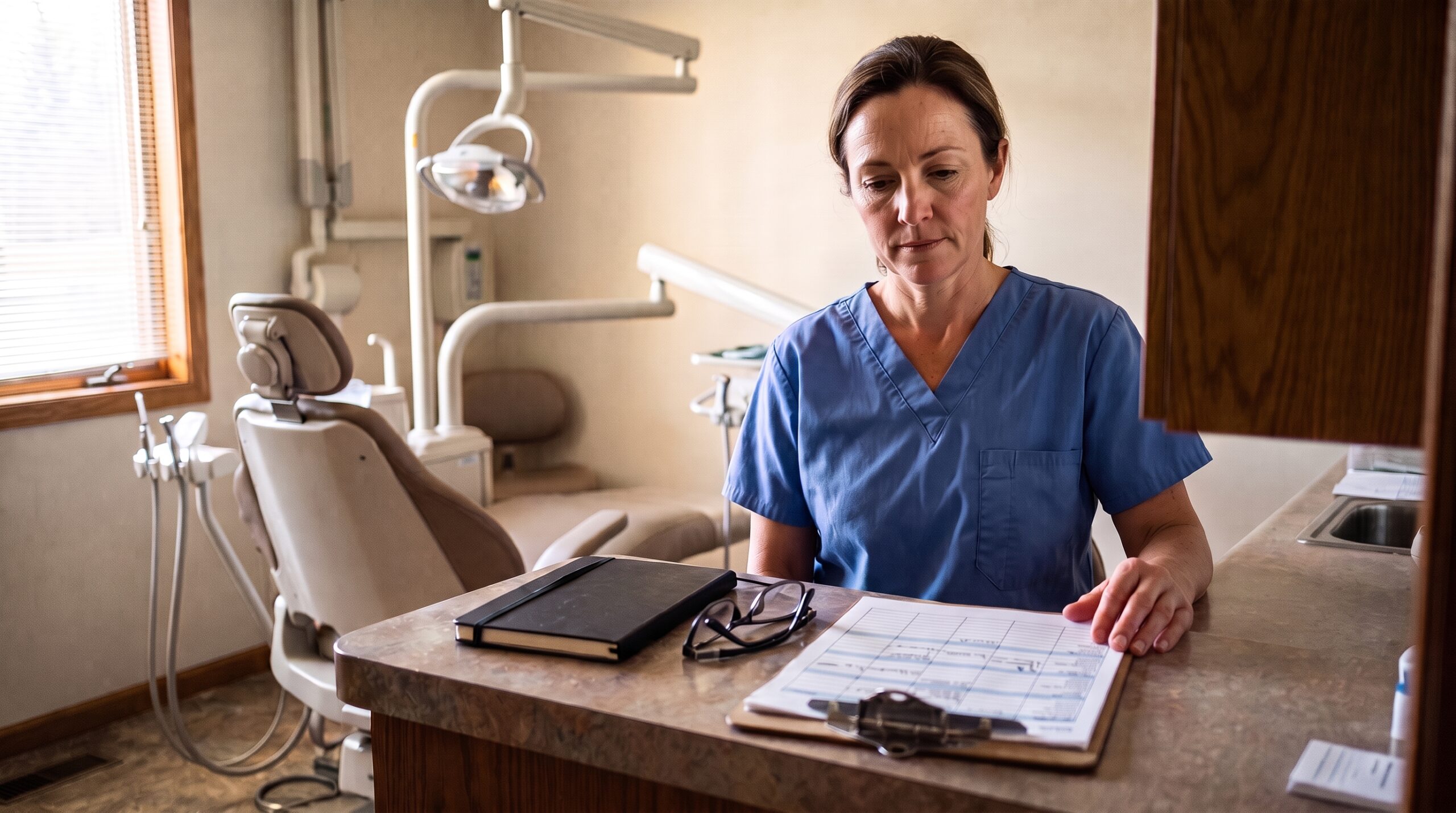
Open the schedule for three weeks out. Look at the hygiene column.
You already know what you are going to see, which is why most owners stop looking. Tuesday has four patients where there should be nine.
Thursday is worse.
And somewhere in the software there is a recall list that has quietly grown past a thousand names. Most of them are people who like you and would come in if anybody called.
The ad has been up since March. You have paid to boost it twice.
So let me say the thing nobody said to you when you bought this practice. The reason your ad is not working is not that you wrote a bad ad.
Something structural changed, and the standard playbook stopped functioning around 2021. Most of what owners try first is aimed at the wrong problem entirely.
Let us do this properly, then. What is actually happening, what to stop wasting money on, and the six things that move the needle, roughly in the order I would try them.
Key takeaways
- This is a retention problem, not a pipeline problem. Hygiene programs graduated a record class in 2025 and the shortage did not move, because new graduates replace people leaving rather than growing the pool.
- Pay alone rarely closes it. Nearly half of hygienists report no benefits at all, and roughly 6 in 10 report no raise in two years — so an offer that fixes only the hourly rate competes on one axis out of four.
- Schedule flexibility is the cheapest lever you own. Many hygienists work part time by choice; a practice offering staggered starts or a four-day pattern is fishing in a pool that larger employers cannot easily match.
- Some of the empty column is a systems problem. Pre-appointing at the chair, honest recall follow-up and column mapping recover capacity you already have, without hiring anyone.
- An unfilled hygiene chair costs multiples of what the hygienist costs. Lost hygiene production plus restorative that never gets diagnosed typically runs 3 times a hygienist’s fully loaded pay — which is also why buyers price staffing stability.
Why can’t I find a dental hygienist to hire? Because the shortage is driven by retention, not supply. Hygiene programs are graduating record numbers, but those graduates replace people leaving the chair rather than expanding the pool.
Around 60% of dentists report having enough hygienists on staff, and 91% of those actively recruiting call it very or extremely challenging.
What is actually causing the hygienist shortage?
Four things happened at once, and only one of them gets talked about.
Start with the fact that supply is genuinely fine. First-year enrollment in hygiene programs rose 16% between 2020 and 2025, graduate numbers have climbed every year since 2022, and 2025 produced a record graduating class.
None of that helped. The share of dentists reporting adequate hygiene staffing has sat near 60% for three straight years while those graduates arrived.
Which tells you the leak is downstream of the schools.
Then the pandemic took a slice out and never fully gave it back. By late 2020, 7.9% of hygienists had left the workforce — roughly 18,000 people.
That improved to 4.9% by August 2021 as some returned. Fewer than half of those who left came back.
A further 1.6% said they had no intention of working as a hygienist again, a permanent loss of about 3,300 clinicians.
The third thing is the one owners underestimate: the job stopped being worth staying in for a large minority of the workforce. The American Dental Hygienists’ Association now describes the shortage flatly as a retention crisis, and its own survey data explains why.
Nearly 45% of hygienists report no benefits at all. About 59% had received no raise in two years, and roughly three-quarters get no bonus of any kind.
Burnout affects 60.6%, driven by workload at 65.7% and office culture at 62.4%. And 64% say their longest tenure at any single practice is five years or less.
Read that last number again. It describes a profession where changing jobs is normal, which means every hygienist you employ has a live alternative and knows it.
The fourth is money, but not in the direction most owners assume. Adjusted for inflation, average wages for dental office staff have actually declined against prior years, while medical office staff and the wider private sector rose.
So hygienists are simultaneously expensive to you and losing ground themselves. Both things are true, and the tension between them is exactly why this feels unfixable from inside a practice.
| What owners assume | What the data shows | Can you influence it? |
|---|---|---|
| Not enough people are trained | Enrollment up 16% since 2020; record graduates in 2025 | No |
| It’s a temporary post-pandemic dip | Adequate-staffing rate flat near 60% for three years | No |
| They just want more money | ~45% have no benefits; 60.6% report burnout; culture and workload lead the reasons | Yes |
| Everyone is paying the same | Median around $98,100 in May 2025, with a spread from roughly $74,900 to $126,100 | Yes |
| Wait it out and it corrects | Projected deficit of roughly 30,000 hygienists by 2037; 31% of hygienists surveyed plan to retire within 6 years | No |
The two rows you can influence are the whole article. Everything else is weather.
Where you practise matters more than it used to
Geography is doing a lot of quiet work here. Median pay was about $98,100 a year in May 2025, or $47.16 an hour, but the state spread is wide enough that a number from a colleague two states away is worse than useless.
Washington sits highest, and stays highest even after adjusting for cost of living. California carries roughly 17,800 hygienist licences against about 36,200 dentist licences.
The Bureau of Labor Statistics projects hygienist employment growing 7% from 2024 to 2034, with around 15,300 openings a year. That is real growth in demand landing on a pool that is not growing.
One more geographic factor is finally moving in owners’ favour. The Dentist and Dental Hygienist Compact now has roughly a dozen states signed on, with more pending, which over time widens the candidate radius for practices near a state line.
What does not work
I want to be blunt about three things, because owners spend real money on all of them.
Reposting the same advertisement. If a listing has been live for 60 days with no qualified applicants, boosting it does not fix a message problem — it buys more impressions for a message that is already being ignored.
Most hygiene ads lead with the practice’s tenure and the word “family.” Almost none lead with the schedule, the benefit package, the number of assisted columns, or what the last hygienist’s day actually looked like. Those are the things a candidate is screening for.
Raising the hourly rate and changing nothing else. Pay is necessary and it is not sufficient.
If nearly half the workforce has no benefits and 6 in 10 cite burnout and culture, an offer competing only on rate is competing on one axis out of four.
I have watched owners go to the top of their local band, hire someone, and lose her in eleven months to a practice paying slightly less with a four-day week. The rate got her in the door.
It was never what kept her.
Waiting it out. There is no cavalry. The pipeline is already at record output and the gap did not close; the projected national deficit runs to about 30,000 hygienists by 2037.
Waiting is a decision, and it is the one with the largest running cost — which we will get to with actual arithmetic.
What actually works, roughly in order of leverage
None of these is quick. All of them are more tractable than they feel at 7pm on a Thursday with the schedule open.
1. Benchmark compensation to your real local market, not your memory of it
Most owners are pricing against what they paid in 2021 with a bit added. That is not a benchmark, it is a recollection.
Pull the actual numbers for your state and metro. Then decide deliberately whether you sit at market, above it, or below it.
Sitting below it is a legitimate choice if the rest of your offer is genuinely strong. Sitting below it by accident is how columns stay empty for nine months.
Then look at benefits separately from wage. Health contribution, paid time off, continuing-education funding and a retirement match are where the largest share of the profession reports a total gap — which makes them cheap differentiation rather than expensive parity.
2. Sell the schedule, because it is the thing you own and a large group cannot copy
Many hygienists work part time, and a meaningful share do so by choice rather than necessity.
A practice that can offer a four-day week, a staggered start, a school-hours block or two long days is fishing in a pool a rigid employer cannot reach.
This is the single most underused lever I see. It costs nothing on the profit and loss statement and it is genuinely scarce.
Say it in the first line of the advertisement. Not paragraph four.
3. Assistant-supported hygiene, if your state permits it
An assisted hygiene column — where a trained assistant seats, takes radiographs, and turns rooms while the hygienist works — can lift the number of patients one clinician sees in a day without lengthening the day.
⚠️ Whether a particular duty may be delegated, and to whom, is set by your state dental practice act — and the rules vary enormously between states.
Some states permit a great deal. Some permit very little.
Several require documented training or a specific certification kept on file at each location.
Do not take a colleague’s arrangement from another state as a template. Read your own board’s rules, or ask them directly, before you build a column around it.
4. Expanded-function auxiliaries, on the same caveat
The same logic applies further up. In states that allow it, an expanded-function dental assistant — an assistant credentialed to perform additional reversible procedures under a dentist’s supervision — can absorb chair time that is currently yours.
That does not fill the hygiene chair directly. What it does is free enough of your own capacity that a thin hygiene column stops dictating the whole practice’s output.
Again: your state board defines the scope, the training requirement and the supervision level. Check before you plan.
5. Build an actual relationship with a hygiene programme
This is the slowest item and the one with the longest tail. Practices that solved hygiene durably almost always did it by becoming a known quantity to a nearby programme.
Take students for observation. Offer to speak.
Hire a new graduate and mentor her properly rather than dropping her into a full column on day one.
The programme director will remember three practices in the region, and being one of them is worth more than any advertisement you will ever buy.
6. Retention, which is really number one
I have put this last because it lands hardest here, after everything above.
The cheapest hire is the one you do not lose. If 64% of hygienists report five years or less at their longest post, then the practice that keeps someone eight years has built something structurally unusual, and it compounds.
The levers are not mysterious. Around 62% of hygienists say greater clinical autonomy would make them more likely to stay.
Workload and culture outrank pay as reasons for burning out.
That means column length, room turnover, whether the schedule gets stuffed when someone calls in sick, whether her periodontal diagnoses get supported at the exam, and whether anyone has asked her what she thinks in the last year.
None of that is on a wage survey. All of it decides whether you are hiring again in eighteen months.
How much of this is a systems problem rather than a hiring problem?
Here is a genuinely awkward pair of facts sitting next to each other.
More than 90% of recruiting dentists call hygiene hiring very or extremely challenging. At the same time, around a third of dentists report not being busy enough.
Both can be true in the same practice. You can be short a clinician and still be leaking capacity from the one you have.
Three places that capacity usually hides:
Pre-appointing at the chair. Patients who leave with the next visit already booked come back at far higher rates than patients who leave with “we’ll call you.”
If your team stopped pre-appointing during the disruption years and never restarted, that alone can account for a visibly thinner column.
The recall list nobody works. Most practices have a substantial share of active patients overdue at any given moment.
That list decays fast. The longer someone has been dormant, the lower the odds of getting them back, so a list worked quarterly is worth far more than one worked annually.
Column design. Fixed 60-minute slots for every patient regardless of periodontal status, no interval variation, no short-slot recall day. Mapping the column to what patients actually need frequently recovers a visit or two a day with no new hire.
I am not claiming systems work replaces a hygienist. I am claiming that owners routinely run at 80% of their existing capacity while searching for 120%, and the first job is worth doing while the second one drags on.
What does an empty hygiene chair actually cost?
This is where I would want you to stop reading and open your own numbers, because the answer is almost always larger than owners guess, and it changes what a sensible pay decision looks like.
Run it for one unfilled column, four days a week:
| Line | How to work it out | Worked example |
|---|---|---|
| Hygiene visits lost in a year | days per week × patients per day × working weeks | 4 × 8 × 46 = 1,472 visits |
| Hygiene production lost | visits × your average hygiene visit value | 1,472 × $185 ≈ $272,000 |
| Restorative never diagnosed | visits × diagnosis rate × average case value | 1,472 × 15% × $550 ≈ $121,000 |
| Total collections not earned | add the two above | ≈ $393,000 |
| Fully loaded cost of the hygienist | wage + payroll taxes + benefits | ≈ $115,000 to $135,000 |
Replace every one of my assumptions with your own — visit value especially, since payer mix moves it enormously. The shape will hold even if the numbers shift.
The third row is the one that matters, and it is the one owners never count. Hygiene is where periodontal disease gets staged, where the cracked cusp gets spotted, where a deferred crown gets raised again.
An empty chair does not just lose the prophylaxis fee. It loses the diagnosis that would have filled next quarter’s restorative schedule.
Now put the two halves together. The chair is generating something in the region of 3 times what the person sitting in it costs.
So a $6-an-hour premium over your local band — about $12,000 a year on a full-time schedule — is not the expensive decision in this scenario. Leaving the column empty for another nine months is.
I am not telling you to overpay reflexively. I am telling you that the arithmetic almost never supports holding out for a bargain, and most owners are running the comparison in their head without ever writing it down.
Does hygiene staffing affect what my practice is worth?
Yes, and this is the part that connects an operational headache to a decision most owners are also quietly weighing. I will keep it short, because it is only relevant if you are within a few years of stopping.
Buyers do not value your practice on collections. They value it on adjusted EBITDA — what the practice earns in pure operating profit after paying a market-rate dentist to do the work you currently do yourself — and then apply a multiple to that number.
Chronic understaffing shows up in three places at once on that calculation.
Hygiene percentage falls. Hygiene production as a share of total collections is read by buyers as a proxy for recurring, transferable patient revenue. A thin hygiene column reads as a thin recurring base.
Owner-dependent production rises. When you cover the gap by producing more yourself, the earnings that survive your departure shrink. Reliance on a single producer is currently one of the most common reasons a group restructures or walks away from a practice.
The trailing twelve months is what gets priced. Not the fixed version. Not the explanation.
A practice that had an empty hygiene chair for most of last year presents a year of suppressed collections, and no amount of context fully repairs that in a negotiation.
Which produces something more useful than a sales pitch. The work that fixes your staffing and the work that raises your price are largely the same work.
If you are 3 years from wanting out, the hygiene problem is not a distraction from the exit plan. It is the exit plan’s first phase.
And if you are not thinking about selling at all, none of that costs you anything — you just end up with a practice that is easier to own.
One thing I would add. When owners do eventually go to market, what they get depends far less on which buyer they pick than on how many are competing at once.
That is what the Elite Selling System is built to produce. We vet and hand-pick every buyer allowed to bid, the way a good host decides who gets past the rope, then run a private competitive window inside that group.
If you want to know where a fixed hygiene column would actually put you, that starts with a free, confidential practice value estimate — and it fairly often ends with us telling an owner to spend two years on staffing first.
Our fee is entirely success-based, so we have no reason to talk anyone into a transaction that is not right for them.
Frequently asked questions
Why can’t I find a dental hygienist to hire?
Because the shortage is driven by retention rather than supply. Hygiene programmes are graduating record numbers, but new graduates are replacing people leaving the chair rather than expanding the pool.
Around 60% of dentists report adequate hygiene staffing, and 91% of those recruiting describe it as very or extremely challenging.
Is the dental hygienist shortage getting better or worse?
Structurally it is not improving, though there are small positive signals in job satisfaction. The adequate-staffing rate has sat near 60% for three years despite record graduate output, and one projection puts the national deficit near 30,000 hygienists by 2037.
Plan on the constraint persisting rather than resolving.
How much should I pay a dental hygienist in 2026?
Benchmark to your state and metro rather than a national figure. The national median was about $98,100 a year in May 2025, roughly $47.16 an hour, but the distribution runs from around $74,900 at the 10th percentile to $126,100 at the 90th, and state variation is wide even after adjusting for cost of living.
Can a dental assistant do hygiene work in my practice?
That depends entirely on your state dental practice act. Some states permit assistants to perform a range of delegated duties with documented training or certification; others permit very little.
Rules on supervision level and record-keeping also differ. Confirm with your own state dental board before designing an assisted column.
Does offering a four-day week actually help me hire a hygienist?
It is one of the most effective and least expensive things a private practice can offer. Many hygienists work part time, a large share by choice, and schedule flexibility is something a smaller practice can move on faster than a large employer can.
Put it in the first line of the advertisement, not the fourth paragraph.
What does an unfilled hygiene chair cost my practice?
Typically around 3 times what the hygienist would cost. A four-day column running 8 patients a day is roughly 1,472 visits a year; at a $185 average visit that is about $272,000 of hygiene production, plus the restorative treatment that never gets diagnosed because nobody was in the chair to find it.
Will hygiene staffing problems lower what my practice is worth?
Yes, in three ways at once. Hygiene production as a share of collections falls, production becomes more dependent on the owner, and the trailing twelve months that a buyer prices shows the suppressed numbers rather than the explanation.
Reliance on a single producer is among the most common reasons a group restructures or walks away.
Should I fix my hygiene staffing before I sell?
If you have the runway, yes. Buyers price the trailing period rather than the plan, so a fixed column needs several quarters of history behind it to count.
The same work that makes the practice more valuable also makes it more bearable to own, which is unusual — most pre-sale preparation only pays once.
Sources
Workforce data and the shortage itself
- ADA Health Policy Institute. “Dental Hygienist Shortage.” ada.org
- ADA Health Policy Institute. “The State of the U.S. Dental Economy, Q1 2026 Update.” ada.org
- ADA Health Policy Institute. “Dental Workforce Shortages: Data to Navigate Today’s Labor Market.” ada.org
- ADA Health Policy Institute. “Dentist Workforce.” ada.org
- ADA Health Policy Institute. “Dentist Retirements Increase.” ada.org
- American Dental Association. “Research reveals impact of COVID-19 on dental hygienists.” ada.org
- ADA News. “Hygienist study reports low COVID-19 infection rate, high vaccination rate, slow return to work.” adanews.ada.org
- Journal of Dental Hygiene (ADHA). “Employment Patterns of Dental Hygienists in the United States During the COVID-19 Pandemic: An Update.” jdh.adha.org
Retention, compensation and why hygienists leave
- American Dental Hygienists’ Association. “Position Statement: Update on Dental Hygiene Workforce Solutions” (April 2026). adha.org
- American Dental Hygienists’ Association. “ADHA Position Statements.” adha.org
- DrBicuspid. “ADHA updates position statement on workforce shortage.” drbicuspid.com
- DrBicuspid. “Dental hygienists in the U.S. aren’t happy.” drbicuspid.com
- Becker’s Dental Review. “There are more hygiene graduates, so why is there still a shortage?” beckersdental.com
- Becker’s Dental Review. “Dentistry’s pay conundrum.” beckersdental.com
- Becker’s Dental Review. “Dentistry’s shifting workforce: 5 key trends.” beckersdental.com
Wages, projections and licensure
- US Bureau of Labor Statistics. “Occupational Outlook Handbook: Dental Hygienists.” bls.gov
- US Bureau of Labor Statistics. “Occupational Employment and Wage Statistics: Dental Hygienists (29-1292).” bls.gov
- Becker’s Dental Review. “Dental hygienist pay in each state, adjusted by cost of living.” beckersdental.com
- American Dental Association. “Seventh State Approves Legislation Establishing Dental Compact.” ada.org
Scope of practice — check your own state
- New York State Office of the Professions. “Scope of Practice Changes for Dental Hygienists.” op.nysed.gov
- Iowa Department of Inspections, Appeals and Licensing, Dental Board. “Expanded Functions.” dial.iowa.gov

Melani Seymour, co-founder of Transitions Elite, helps veterinary practice owners take action now to maximize value and secure their future.
With over 15 years of experience guiding thousands of owners, she knows exactly what it takes to achieve the best outcome.