
CORDENTAL Group and Your Dental Practice: What Owners Should Know in 2026
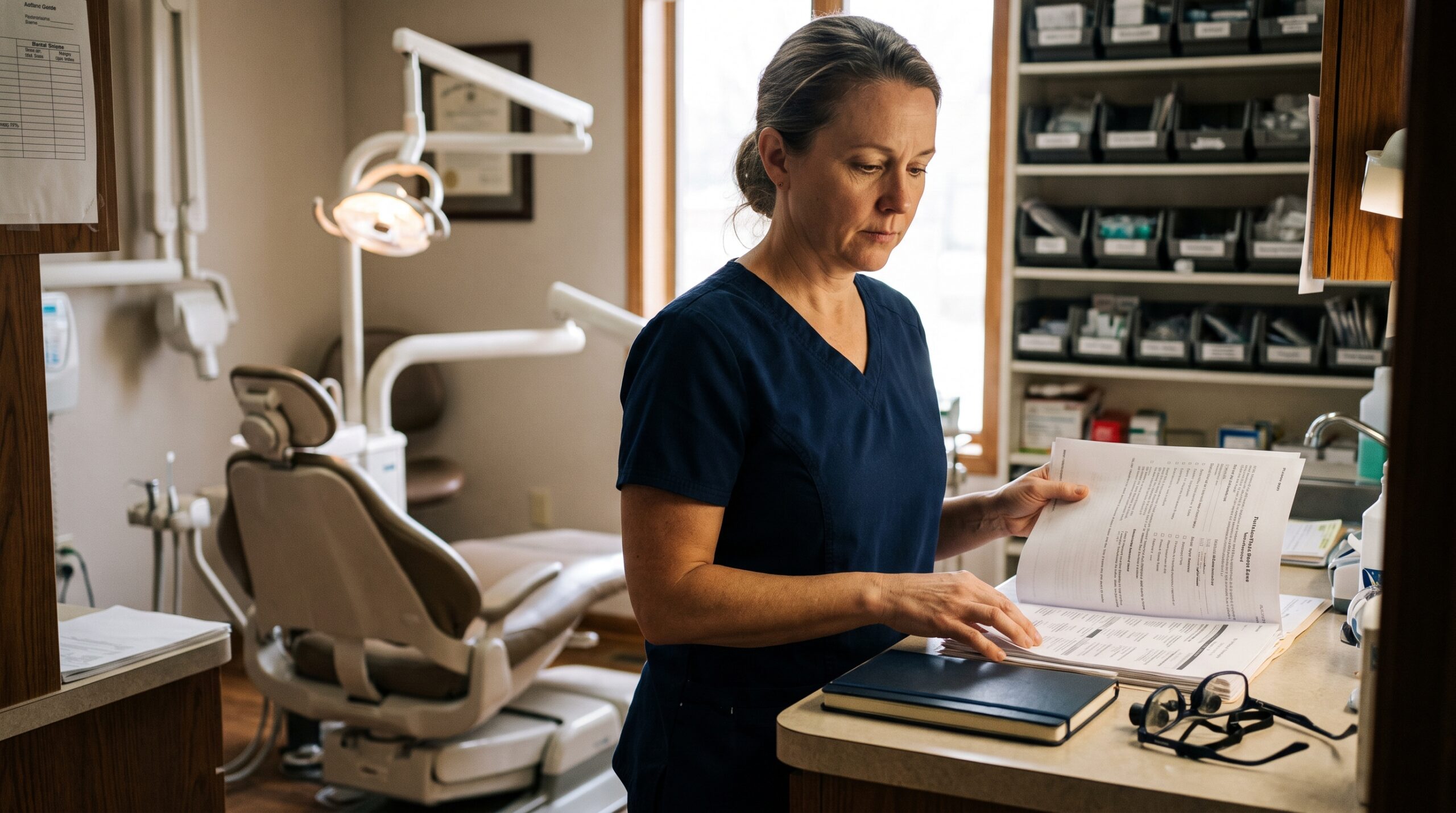
The call comes from a Cincinnati number you do not recognize.
The person on the other end is polite, specific, and has clearly looked at your practice. They know how many operatories you run.
They mention the town over, where they already support two offices.
Then they say the sentence that ends your evening. “We’d love to talk about a partnership.”
You have never heard of them. That is the first thing you notice, and it is the thing that bothers you most.
So you do what every dentist does at nine that night. Laptop open, practice closed, name typed into Google.
Here is what you should find.
Key takeaways
- CORDENTAL Group is a genuine buyer of existing practices. It supports 45-plus affiliated practices across nine states from a Cincinnati headquarters, and it publishes its affiliation process openly.
- Its size is the point, not a drawback. Regional platforms in the dozens-of-offices range do a large share of the affiliations in dentistry, and the household names are not automatically your most likely buyer.
- One practice moves a 45-office platform in a way it cannot move a 1,500-office one. That arithmetic is why smaller buyers are frequently hungrier.
- Smaller platforms carry a structural trade-off. Less capital depth sector-wide means rolled equity is a more concentrated bet. That is a feature of scale, not a criticism of anyone.
- Announced deal flow is quiet at this end of the market. Most mid-size affiliations never get a press release, so silence is a poor guide to appetite. Ask directly instead.
Does CORDENTAL Group buy dental practices? Yes. CORDENTAL affiliates existing independent practices rather than building new offices, supporting more than 45 practices across nine states.
It is a portfolio company of NMS Capital and publishes a seven-step affiliation process on its own site.
Who CORDENTAL Group actually is
Founded in March 2017. Two people, Dana Soper and Steven Jones, backed with committed capital from New MainStream Capital, now NMS Capital.
The headquarters is on Kenwood Road in Cincinnati. It has been there the whole time.
Today the group supports more than 45 affiliated practices across nine states: Iowa, Illinois, Minnesota, Missouri, Ohio, Pennsylvania, Tennessee, Virginia and Wisconsin.
Read that list again, because the shape of it tells you something. Six of the nine are Midwestern.
Two are Mid-Atlantic. One is Southeastern.
This is a Midwest-anchored organization that has reached east, not a national one.
A word on the label. A DSO is a dental support organization: the management company owns the non-clinical side of a practice and handles everything outside the operatory, while a licensed dentist retains ownership of the clinical entity.
That split is not a marketing preference. Most states restrict who may own or control a dental practice under the corporate practice of dentistry doctrine, and the DSO structure exists to operate inside those rules.
Ownership sits with NMS Capital, a New York private investment firm that spun out of the Goldman Sachs Merchant Banking Division and focuses on lower-middle-market healthcare and services companies. Its own portfolio page lists CORDENTAL as a current holding, from its second fund, since 2017.
The chief executive is Len Schiavone, appointed in 2024. His background matters more than most CEO bios do, and I will come back to why.
Does CORDENTAL buy existing practices, or build new ones?
Buys. Plainly and openly.
This is worth stating because two of the three largest DSOs in the country do the opposite. Aspen Dental and PDS Health grow primarily by opening new offices, and of the three biggest only Heartland Dental is substantially acquisition-led.
An owner who assumes the largest names are all bidding for existing practices is working from a false map.
CORDENTAL is not on that map at all. Its entire growth model is affiliation, branded internally as the C.O.R.
Affiliate Strategy — Collaborate, Optimize, Respect.
And it publishes the process. Seven steps, on a public page.
Confidentiality agreement signed. Practice overview provided.
Valuation and affiliation structure established after an after-hours site visit. Letter of intent and offer extended.
Offer accepted, then deeper diligence. Legal agreements and staff integration.
Closing.
That is more transparency about sequence than most buyers offer. It also gives you a checklist to hold them to.
One honest observation about cadence. The publicly announced affiliations run 43rd in May 2024, 44th in August 2024, 45th in January 2025, and I could not find a public announcement after that.
Do not over-read the silence. At this size, most affiliations are never announced at all — a press release is a marketing decision, not a transaction record.
But do ask. “How many practices have you added in the last eighteen months?” is a fair question, and a straightforward organization answers it in one sentence.
The mid-market sweet spot, and why it inverts your instincts
Most owners assume the biggest brand is the most likely buyer. The market says otherwise.
Becker’s Dental Review tracked more than 200 DSO affiliations across 2025, more than 70 in the first quarter of 2026 alone, and more than 130 in 2026 through the reporting date.
Those deals are not concentrated in four famous names. They are spread across dozens of platforms, most of which the average dentist could not name.
The Association of Dental Support Organizations alone counts more than 80 member companies supporting over 8,500 practices and roughly 15,000 dentists.
Now do the arithmetic that explains the behavior.
A practice collecting $2.6 million joining a 45-office group adds a little over two percent to that organization’s footprint. The same practice joining a 1,500-office group adds seven hundredths of one percent.
One of those buyers has a reason to fight for you. The other one genuinely does not.
That is not a comment on anybody’s character. It is a spreadsheet.
Regional platforms also have a specific reason to want density. Filling a hole in a market where you already run three offices delivers shared staffing, shared purchasing and referral flow.
A scattered addition eight states away delivers none of that.
CORDENTAL has said as much publicly, going back years. Market density inside supported geographies is the stated goal.
There is a third effect owners underestimate, and it is the one that shows up in your actual experience of the deal.
Fewer layers. At a 45-office organization the chief executive may well be in the room.
At a national platform with hundreds of practices, a $3 million transaction sits in a much longer queue.
Which brings me back to Schiavone. Before CORDENTAL he was chief corporate development and integration officer at one dental group and chief acquisition officer at another.
A company that hires a deal-and-integration executive to run it is telling you what it intends to spend the next few years doing.

The honest counterpoint about smaller platforms
I would be doing you no favors if I stopped there. Scale cuts both ways, and this part is structural rather than specific to any one organization.
A smaller platform has less capital depth than a larger one. That is arithmetic, not judgment, and it is true across every sector where mid-market buyers exist.
It shows up in three places that matter to a seller.
Deal certainty. Between a signed letter of intent and a closing sits a diligence period that commonly runs several months. Any buyer whose funding is assembled alongside that process has a timetable that can move.
The cash-at-close mix. Every dollar paid today comes from somewhere. Capital depth affects how much of the price can be weighted toward cash rather than deferred into paper.
What your rolled equity is a claim on. This is the big one, and it is where smaller and larger platforms genuinely differ.
Rollover equity means keeping a slice of ownership in the buyer’s company instead of taking all cash at close. If you take it, its value tracks the whole organization, not your practice.
A stake in a 45-office platform is a more concentrated bet than a stake in a 1,000-office one. Concentration works in both directions.
If the platform grows well and reaches a liquidity event above the valuation at which you joined, a slice of a smaller organization can appreciate more sharply than a slice of a giant.
Owners who affiliated early with groups that then grew have done very well from exactly this.
If growth stalls, the same concentration runs the other way, and there are fewer offices absorbing the shock.
Nobody can tell you in advance which one you are in. Anyone claiming otherwise is guessing, and I would want to know how they are paid.
What you can establish is where the equity sits, what ranks above it in the preference stack, and when a liquidity event is realistically expected. Then price the whole package against a straight cash alternative from somebody else who wants your practice.
The arithmetic, walked through
Abstract talk about structure is useless. Numbers make it decidable.
None of what follows is attached to CORDENTAL or to any named organization. It is the generic shape of a mid-market dental transaction, and the point is the method.
Take a practice collecting $2.6 million. Overhead runs at 60 percent.
The owner produces heavily and pays herself whatever is left in December, which is how most dentists keep score.
Now run the bridge that dental owners almost never run.
Collections minus true operating overhead leaves roughly $1.04 million. Then subtract what it would cost to hire an associate at market rate to do the owner’s own production.
Call it $290,000.
What remains is about $750,000 of adjusted EBITDA — the operating profit left after paying a market-rate dentist to do the work she currently does herself.
That number is what a buyer values. Not collections.
Not production.
And certainly not a “percentage of collections” figure someone quoted in a hallway at a study club. A 120-percent-of-collections number and a 7x-EBITDA number are not comparable until you have done this bridge, and mixing them is the single most expensive error in dental transactions.
Say a buyer values that $750,000 at 7x. The headline is $5.25 million.
Now split it. Seventy percent cash at close is $3.68 million.
Thirty percent rolled is $1.58 million of paper.
Then ask what almost nobody asks. What is the paper actually worth?
If the organization grows and a liquidity event lands above the valuation at which you joined, that $1.58 million can be worth meaningfully more. That is the whole case for taking equity.
If it arrives flat, you get your money back years later, having carried the risk and lost the use of the cash in between.
If liquidation preferences rank above you, common equity can return a fraction of its stated number. That is not a prediction about anyone.
It is how a preference stack works.
And notice the other thing this exposes. The 70/30 split is not physics.
Owners read it as policy. It is frequently an opening position.
Owners who wanted more cash have got more cash — when somebody else was bidding.
What kind of practice CORDENTAL looks for
There is no published revenue threshold, patient-volume minimum or geographic screen. Almost no buyer publishes one, and the ones that do move the goalposts anyway.
The footprint tells you more than a stated criterion would. Nine states, heavily Midwestern, with clusters rather than scattered flags.
A practice that deepens a market CORDENTAL already supports reads differently from one that would plant a lone outpost in a tenth state.
Its own affiliate materials name what it says it preserves: your name, your location and your team. The language is unusually concrete for a page of this kind.
General dentistry with a strong hygiene department fits a group of this shape well. Hygiene production as a share of collections gets read as a proxy for recurring, transferable patient revenue.
Transferability is the underlying test in every case. A practice patients come to for the practice survives your departure.
One they come to only for you is harder to underwrite, and buyers price that gap.
What an offer typically contains
CORDENTAL does not publish a price sheet, and neither does anyone else in this market. What any buyer pays depends on the practice, the geography, their current appetite, their capital position, and above all on who else is bidding.
Any source quoting you a specific multiple for a named buyer is generalizing from a handful of deals it half-remembers.
What holds broadly across the private-equity-backed pool, rather than for any one organization:
Cash at close is typically a portion of the headline figure rather than all of it. Rollover equity commonly makes up part of the balance.
An earnout may make up the rest — part of the price paid later, only if the practice hits agreed targets after closing.
There is also a post-closing employment agreement, almost always. Its length, its compensation formula and its restrictive covenants are terms, not formalities.
Two offers with identical headline numbers can therefore be worth materially different amounts. I have watched an owner take the bigger headline and receive less money.

What changes after the sale
Start with what usually does not change, because at a regional platform it is more than owners expect.
The sign generally stays. CORDENTAL’s stated model is built around keeping the practice name, and its published affiliations name practices that kept their identity with the doctors still leading them.
Clinical autonomy is its stated position too, alongside continuing education for the doctor and the team.
Treat every such statement, from every buyer, as the opening of a conversation rather than the close of one. The reliable way to test it is not the affiliate page.
It is a phone call with two dentists who affiliated at least two years ago. Long enough for integration to have happened and any honeymoon to have ended.
What does change is the back office. Payroll, benefits, insurance contracting, purchasing, marketing, compliance and IT move to a central function.
For a lot of owners that is precisely the point.
Your team’s experience changes with it. New benefits, a new payroll system, new reporting lines for some roles.
Worth knowing before you tell them, not after.
Questions worth asking CORDENTAL specifically
Generic questions get generic answers. These are the ones I would put in front of this particular buyer.
“How many practices have you added in the last eighteen months, and how many do you expect to add in the next twelve?” Asked politely, this is a normal question, and the answer tells you where you sit in their plan.
“Which of your practices are nearest me, and can I speak with two of those doctors?” Ask for them by name rather than accepting whoever is offered. A confident organization arranges that call within a week.
“Does my practice name stay, and is that in the agreement or just the intention?” Their own materials say your name stays. Get it written down anyway.
“Which clinical decisions remain mine, in writing?” Materials, labs, hygiene protocols, scheduling templates, case acceptance targets. Name them one by one.
“If I roll equity, where does it sit and what ranks above it?” Equity in your own practice entity behaves very differently from equity in the parent.
“What is the earnout measured on, and who controls those inputs?” An earnout measured on a number the buyer controls is not really an earnout.
“Who is my day-to-day contact, and how many practices do they support?” That answer shapes your Monday mornings more than any org chart will.
Ask these of every buyer, not only this one. The answers are comparable only if the questions are identical.
How to know whether the offer is competitive
Here is what actually decides your outcome, and it is not whose name is on the letterhead.
A buyer who approaches you directly is competing with nobody. Their offer reflects that.
It would be strange if it did not.
The same organization, bidding against three others who also want your practice, behaves differently. Not because the first number was dishonest.
Because the leverage changed.
The pool is deep enough for that to be real. Roughly 30 to 35 organizations acquire independent general practices at meaningful scale in the United States.
Most owners have heard of four.
And the direction of travel is not slowing. DSO affiliation rose from under 9 percent of US dentists in 2017 to around 16 percent by 2024, while the share of dentists who own their practice has fallen steadily since 2005.
Creating that competition is what the Elite Selling System exists to do. We hand-select and vet every buyer who gets to bid on your practice, the way a doorman with a velvet rope lets in only the right people.
Then we run a private competitive window inside that group. The point is not to squeeze anyone.
It is that you cannot know whether a number is good until a second serious buyer has told you what they think it is worth.
What to do next
If a CORDENTAL approach is sitting on your desk, the first job is not to compare it against your expectations. It is to make it comparable to anything at all.
Get your adjusted EBITDA documented properly, with the owner-production adjustment done honestly rather than optimistically. Separate cash at close from equity from earnout.
Read the employment agreement as carefully as you read the price.
Then find out what the practice attracts when several qualified organizations are competing for it, rather than one.
CORDENTAL may well be the right home. A dentist-centric regional group that keeps your name, publishes its process and has spent nearly a decade deepening the same nine states is a serious partner.
Plenty of dentists have been happy with exactly that shape of deal.
The point is to choose it on the numbers, not on the warmth of the phone call.
We will give you that assessment free and in confidence, including the answer that you should wait eighteen months and fix two things first when that is the honest one. It starts with a free, confidential practice value estimate.
Our fee varies depending on the value of the practice and is entirely success-based. If we do not get you a result, we do not get paid.
Frequently asked questions
Does CORDENTAL Group buy dental practices?
Yes. CORDENTAL affiliates existing independent practices rather than building new offices.
It supports more than 45 practices across nine states and publishes a seven-step affiliation process, from confidentiality agreement through to closing, on its own site.
Who owns CORDENTAL Group?
NMS Capital, a New York private investment firm that spun out of the Goldman Sachs Merchant Banking Division and invests in lower-middle-market healthcare and services companies. It formed CORDENTAL with management in March 2017 and lists it as a current portfolio holding.
How big is CORDENTAL Group, and where does it operate?
More than 45 affiliated practices across Iowa, Illinois, Minnesota, Missouri, Ohio, Pennsylvania, Tennessee, Virginia and Wisconsin, headquartered in Cincinnati. The footprint is Midwest-anchored, with Mid-Atlantic and Tennessee locations rather than broad Southeastern coverage.
Are the biggest DSOs the most likely buyers for my practice?
Usually not. Affiliation volume is spread across dozens of platforms, and of the three largest DSOs only Heartland Dental is substantially acquisition-led.
Aspen Dental and PDS Health grow primarily by opening new offices.
Why would a smaller DSO pay more than a national one?
Because one practice changes a smaller platform’s numbers far more than it changes a large one’s, and because filling a gap in a market it already supports delivers density benefits a scattered national addition does not.
What is the trade-off with a smaller platform?
Less capital depth than a large one, which can affect timetable certainty and the cash-at-close mix, and a more concentrated outcome for any equity you roll. That concentration can work in your favor or against it.
What does CORDENTAL Group pay for a practice?
There is no published price sheet, and any specific multiple attached to a named buyer is generalized from limited data. What any organization pays depends on the practice, the market, their appetite and who else is bidding.
Should I accept a direct offer from CORDENTAL?
Not before other qualified buyers have had the chance to bid. A single offer tells you what one organization will pay when nobody is competing.
It tells you nothing about what your practice is worth.
Sources
CORDENTAL Group scale, ownership and activity
- CORDENTAL Group. “Why COR — Our C.O.R. Affiliate Strategy.” cordentalgroup.com
- CORDENTAL Group. “Who We Are.” cordentalgroup.com
- CORDENTAL Group. “Locations.” cordentalgroup.com
- CORDENTAL Group. “CORDENTAL Group Forms Strategic Partnership with Williamsburg Dental in Pennsylvania,” 27 January 2025. cordentalgroup.com
- CORDENTAL Group. “News and Announcements Archive.” cordentalgroup.com
- New MainStream Capital. “New MainStream Capital Announces Partnership with Management to form the CORDENTAL Group,” 1 March 2017. cordentalgroup.com
- NMS Capital. “Portfolio.” nms-capital.com
- NMS Capital. “CORDENTAL Group news archive.” nms-capital.com
- PitchBook. “Cordental Group Company Profile: Valuation, Funding & Investors.” pitchbook.com
- Becker’s Dental Review. “Cordental Group adds Pennsylvania practice, hits 45 offices.” beckersdental.com
- Becker’s Dental Review. “Cordental Group appoints new CEO.” beckersdental.com
Buyer pool, deal activity and market structure
- Becker’s Dental Review. “130+ DSO affiliations so far in 2026: State-by-state breakdown.” beckersdental.com
- Becker’s Dental Review. “70+ DSO affiliations in Q1: State-by-state breakdown.” beckersdental.com
- Becker’s Dental Review. “200+ DSO affiliations in 2025: State-by-state breakdown.” beckersdental.com
- Becker’s Dental Review. “What the 3 largest DSOs have been up to.” beckersdental.com
- Association of Dental Support Organizations. “About ADSO.” theadso.org
Deal structure, process and regulation
- Mandelbaum Barrett PC. “The Four-Phase DSO Transaction Process.” mblawfirm.com
- Cranfill Sumner LLP. “Selling Your Dental Practice to a DSO.” cshlaw.com
- US House Committee on Oversight. “Survey of State Laws Governing the Corporate Practice of Dentistry.” oversight.house.gov
Ownership trends and practice economics
- Becker’s Dental Review. “16% of US dentists affiliated with a DSO: State-by-state breakdown.” beckersdental.com
- ADA Health Policy Institute. “Practice Ownership Trends in Dentistry: A New Look at Old Data.” ada.org

Melani Seymour, co-founder of Transitions Elite, helps veterinary practice owners take action now to maximize value and secure their future.
With over 15 years of experience guiding thousands of owners, she knows exactly what it takes to achieve the best outcome.