
Dental365 and Your Practice: What Owners Should Know in 2026
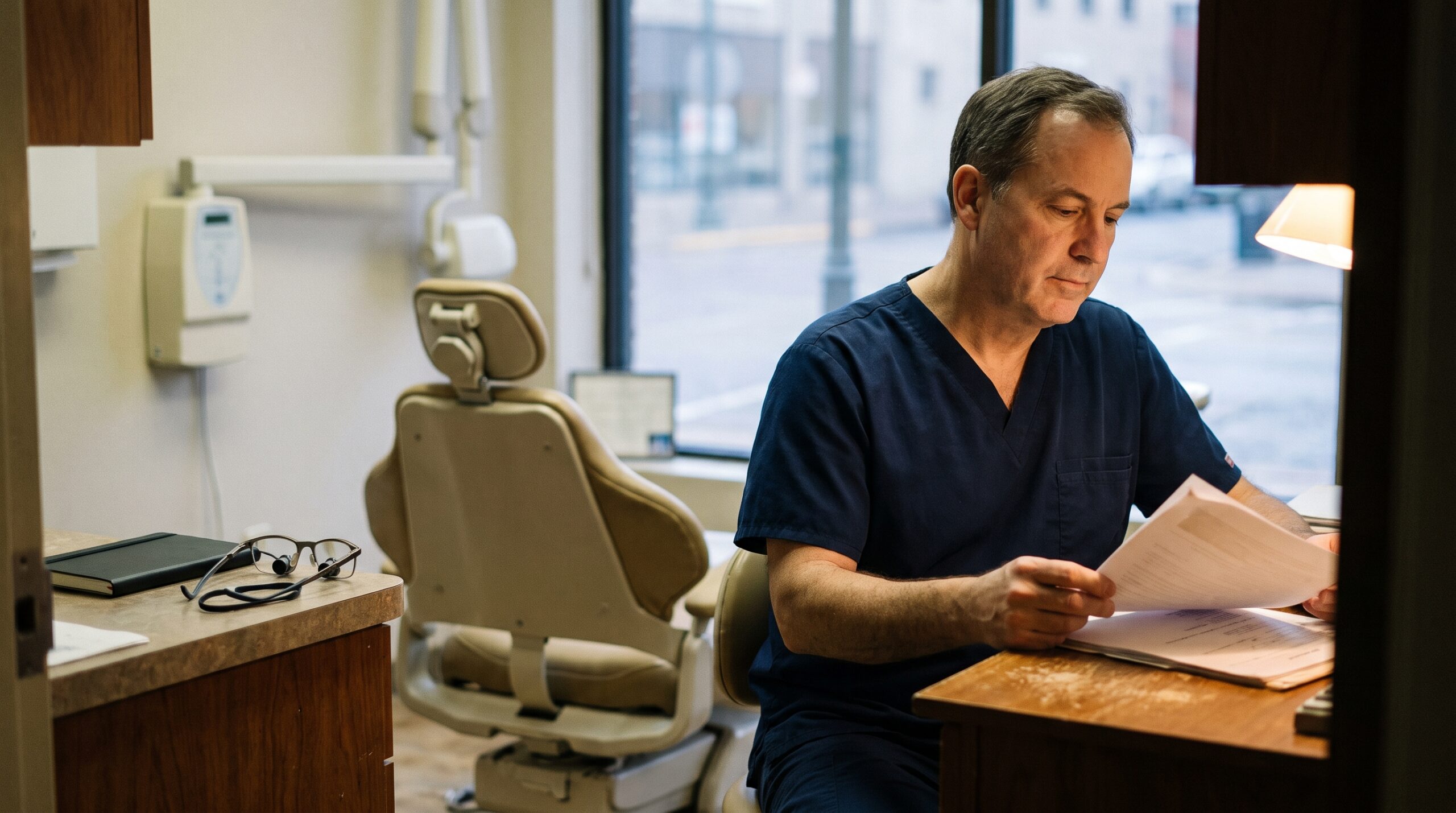
The email arrives from someone at Premier Care Dental Management, and you have never heard of them.
So you search the name. And the first thing you learn is that the company writing to you is the one behind Dental365, the practice with the long hours and the bright signage that opened eleven minutes from your office.
Now the email makes sense. Now you have a different question.
Not “who are these people.” The real question is what your Tuesdays look like eighteen months from now.
That is the question almost nobody researches before they answer the letter. So let me take it seriously.
Key takeaways
- Dental365 is genuinely acquiring existing practices, not just opening new ones. Its own newsroom carries dated affiliation announcements running continuously from August 2025 through July 2026.
- The owner is The Jordan Company, which acquired the platform in August 2021 and still lists it as a current holding. Regal Healthcare Capital Partners kept a minority stake.
- The letter will not say “Dental365.” The acquiring and management entity is Premier Care Dental Management, which supports more than 150 practices across 8 states under several brands.
- The extended-hours model is an operating commitment, not a slogan. Its sponsor describes the platform as offering extended weekday and weekend hours, and accepting only commercial and self-pay patients.
- A buyer’s operating model is a diligence item that runs toward you. You are being evaluated. You should also be evaluating, and getting the answers into the agreement.
Does Dental365 buy existing dental practices? Yes. Through Premier Care Dental Management it has affiliated practices across the Northeast and Ohio at a pace of roughly one announced deal a month, several covering multiple locations.
It is owned by The Jordan Company, which acquired the platform in 2021.
Who Dental365 actually is
It started in 2014, with one office in Park Slope, Brooklyn. The company’s own account is blunt about what happened next: it “became extremely busy very quickly.”
The founders were Dr. Scott Asnis and Dr.
David Kim. Manhattan and Long Island followed.
Twelve years later the consumer-facing site advertises over 100 locations.
Here is the piece that trips owners up. Dental365 is the practice brand. Premier Care Dental Management is the company.
PCDM is headquartered in New Hyde Park, New York. On its own site it says it supports more than 150 general, pediatric, orthodontic and specialty practices across the Northeast.
Its January 2026 announcements name eight states: New York, Connecticut, New Jersey, Pennsylvania, Ohio, New Hampshire, Massachusetts and Rhode Island.
Several brands sit underneath. Dental365 for general dentistry.
Leading Edge Specialized Dentistry for the specialty side. Beacon Dental Health in Massachusetts and Rhode Island.
A word on the terminology, since it matters to the structure. A DSO is a dental support organization: the management company owns the non-clinical side of a practice and handles everything outside the operatory, while a licensed dentist keeps ownership of the clinical entity.
That split is not a preference. Most states restrict who may own or control a dental practice under the corporate practice of dentistry doctrine, and the DSO structure exists to operate inside those rules.
Interestingly, PCDM’s own materials now describe it as a “Dental Clinical Organization.” Read that as positioning rather than a different legal animal.
Does Dental365 buy existing practices, or build new ones?
Buys. And it is worth saying plainly, because in dentistry that answer is not automatic.
Two of the three largest DSOs in the country grow primarily by opening new offices rather than acquiring established ones. An owner who assumes every big name is bidding for existing practices is working from a bad map.
Dental365 sits firmly in the acquiring group. It also opens the occasional new office and consolidates existing ones into a new site, which its April 2026 Westfield announcement describes as uniting two trusted practices.
Both things are true at once. But the growth engine is affiliation.
The Jordan Company still lists Dental365 as a current portfolio holding, which is the single cleanest signal that the capital behind the buying is still in place.
The pace, read from their own announcements
I would rather show you the record than characterize it. Here is what the company published about itself over twelve months.
August 2025. Two Pennsylvania practices, Garden Spot Dental Care in New Holland and Hempfield Dental Care in Lancaster. Ten days later, the Ohio entry: six practices plus a new endodontic office in the Toledo area.
Autumn 2025. Nataupsky Family Dentistry in Kingston, Pennsylvania in late September. Van Buren Dental in Kettering, Ohio in October.
Woodville Dental Care in northwest Ohio in November.
2026. Great Smiles Family Dentistry on 5 January. Laskey Dental Care the same month.
Blank Dental Group, three Ohio locations, on 26 January.
Then Lebanon County, Pennsylvania in March, with two practices at once. Specialty additions in northwest Ohio and King of Prussia.
A Toledo practice in May. Brookline Smile Artists in Massachusetts in July.
Becker’s Dental Review counted 12 moves across 2025, a tally that includes a scholarship relaunch and an education partnership alongside the deals.
Two honest caveats. Announcements are not practices, and several of these covered more than one location.
And a company chooses what it announces.
But you cannot fake a dated public record twelve months long. The posture is real, and it is current.
That still does not tell you whether they are right for your practice. Which brings us to the part nobody writes about.

The operating model is the thing to diligence
Read what the sponsor says about the asset it bought. The Jordan Company’s own portfolio description calls Dental365 dentist-led, and says it “offers extended weekday and weekend hours to drive high patient retention and accepts only commercial and self-pay patients.”
Sit with that for a second. Then read it again as an owner rather than an investor.
Extended weekday and weekend hours is not a marketing line. It is a description of how the offices run.
Individual Dental365 locations publish evening hours into the seven o’clock hour and weekend availability, including Sundays at some sites. The company describes itself as having been among the first to offer routine and walk-in emergency care seven days a week.
This is a legitimate and successful way to run dentistry. The Association of Dental Support Organizations makes flexible office hours one of its stated advantages of DSO support.
Patients plainly like it.
But it has consequences that land on your side of the table.
Chair time. A practice running four days and 32 clinical hours is a different operation from one running six days and 48. That is 50 percent more coverage to staff.
Your team. The people who have worked Monday to Thursday for nine years did not sign up for Saturdays. Some will adapt happily.
Some will leave, and in the Northeast a hygienist is not quickly replaced.
Your own hours. How many of those evenings and weekends are yours? That answer belongs in your employment agreement, in writing, not in a conversation you half-remember.
Your payer mix. The commercial-and-self-pay line is the one I would confirm is still current, and then measure yourself against. If a meaningful share of your chair time is government-plan patients, that is a fit conversation to have in week one rather than month five.
None of that is a criticism. It is a fit question, and fit questions have good answers as often as bad ones.
Plenty of practices already run late nights and Saturdays and would find the model a relief.
The point is the general one, and it applies to every buyer you will ever talk to.
A buyer’s operating model is a diligence item running in the opposite direction. They are underwriting you. You should be underwriting them.
Owners spend six weeks assembling production reports, aging schedules and hygiene metrics so a buyer can decide whether the practice fits. Almost nobody spends six hours deciding whether the buyer fits the practice.
| What the model implies | What to establish before you sign |
|---|---|
| Extended weekday and weekend hours | The exact schedule expected of your office, and whether it changes at closing or later |
| Your post-sale clinical hours | Named days and hours in the employment agreement, not “as reasonably required” |
| Staffing to cover the schedule | Who hires, who pays, and what happens if the roles cannot be filled |
| Commercial and self-pay orientation | Whether your current payer mix is expected to change, and on what timetable |
| Consumer-brand marketing engine | Whether your practice name converts to Dental365, and when |
| Central scheduling templates | Which scheduling and clinical decisions remain yours, listed individually |
The arithmetic, walked through
Abstract talk about fit is useless. Numbers make it decidable, so let me build one.
Take a Northeast general practice collecting $2.9 million. Overhead runs 61 percent.
The owner produces heavily and takes whatever is left at year end, which is how most dentists keep score.
Now do the bridge dentists almost never do.
Collections minus true operating overhead leaves about $1.131 million. Then subtract what it would cost to hire an associate at market rate to do the owner’s own production.
Call it $310,000.
What remains is roughly $821,000 of adjusted EBITDA — the operating profit after paying a market-rate dentist to do the work she currently does herself.
That number is what a buyer is valuing. Not collections.
Not production.
And emphatically not a “percentage of collections” figure someone quoted at a study club. A 120-percent-of-collections number and an 8x EBITDA number are not comparable until you have done this bridge.
Take an illustrative 8x, a figure that belongs to no particular buyer and is used here only to make the structure visible. The headline is about $6.57 million.
Split it the way these deals commonly split. Seventy percent as cash at close is roughly $4.60 million.
Thirty percent as rollover equity — keeping a slice of ownership in the buyer’s company instead of taking all cash — is about $1.97 million of paper.
Now run the second calculation, the one this article exists for.
Her practice is open four days. The model she is joining runs six, with evenings.
Her 32 clinical hours become something closer to 48.
Who works those 16 hours? If it is her, the employment agreement she is about to sign describes a materially different life from the one she has now.
If it is new hires, someone is recruiting a hygienist and two assistants into a tight Northeast labor market, and the cost of that sits inside the EBITDA she is being paid a multiple on.
Neither answer is wrong. Not knowing which one it is, on the day you sign, is the mistake.
What kind of practice Dental365 looks for
There is no published revenue threshold or patient-volume screen. Almost no buyer publishes one, and the ones that do move the goalposts anyway.
The footprint tells you more. The Northeast corridor is the core, and Ohio is the live expansion.
That Ohio push is worth noticing. Six practices at once in the Toledo area, then Kettering, then Woodville, then three more in January.
That is a company building density in a market, not planting a flag.
Density is usually where a regional platform pays best. Filling a gap in a market it already runs delivers shared costs and referral flow that a scattered addition does not.
The mix spans general dentistry, pediatrics, orthodontics, endodontics, periodontics and oral surgery, with Leading Edge carrying the specialty side.
A general practice with a strong hygiene department reads well here. Hygiene production as a share of collections gets treated as a proxy for recurring, transferable patient revenue.
PCDM publishes its own affiliation path: an introduction, then valuation, offer and letter of intent, then onboarding. Useful to know, mostly because it tells you how compressed the middle step is.
What an offer typically contains
Dental365 does not publish a price sheet, and neither does anyone else in this market. What any buyer pays depends on the practice, the geography, their appetite, and above all on who else is bidding.
Anyone quoting you a specific multiple for a named buyer is generalizing from a handful of deals they half-remember.
What holds broadly across the private-equity-backed pool, rather than for any one organization:
Cash at close is typically a portion of the headline figure, not all of it. Rollover equity usually makes up part of the balance.
An earnout may make up the rest — part of the price paid later, only if the practice hits agreed targets after closing. A portion of the price is also commonly held back by the buyer for a defined period to secure your representations.
Then there is the post-closing employment agreement. Nixon Peabody’s dental team lists it among the issues to settle before signing, and notes that restrictive covenants have to be tested against each state’s own law rather than assumed enforceable.
Mandelbaum Barrett’s national dental group describes holdbacks, rollover rights and earnouts as the terms that actually get negotiated in these transactions.
Two offers with identical headline numbers can therefore be worth materially different amounts. I have watched an owner take the bigger headline and end up with less money.

What changes after the sale
Start with the back office, because that part is predictable. Payroll, benefits, insurance contracting, purchasing, marketing, compliance and IT move to a central function.
For many owners that is the entire appeal.
The brand question is genuinely open here, and worth asking directly. PCDM runs several banners, so a local name surviving is possible.
But Dental365 is a consumer marketing engine with real recognition in its markets, and the April 2026 Westfield opening carried the Dental365 name. Ask specifically, and get the answer written down either way.
Clinical autonomy is the standard commitment, and Dental365’s own materials describe the company as dentist-founded and dentist-led. Treat any such statement, from any buyer, as the start of a conversation rather than the end of one.
The reliable test is not the pitch deck. It is a phone call with two dentists who affiliated at least two years ago, long enough for integration to have happened and the honeymoon to have ended.
And then the one specific to this model. Your team’s week may change shape.
New payroll, new benefits, new reporting lines, and possibly new days.
Better to know that before you tell them than after.
Questions worth asking Dental365 specifically
Generic questions get generic answers. These are the ones I would put in front of this particular buyer, in this order.
“What schedule will my office be expected to run, and from what date?” Not “do you have extended hours.” The specific days and hours for your specific location, and the timetable for getting there.
“Which of those hours are mine?” Then get the answer into the employment agreement as named days, not as a reasonableness standard.
“If we need a hygienist and two assistants to cover the new schedule, who recruits and who carries the cost?” A model that depends on staffing you do not yet have is a plan with a dependency in it.
“Is the commercial and self-pay orientation still current, and how does my payer mix fit?” Ask it flatly. It is a fit question, not an accusation.
“Does my practice name stay, and is that in the agreement or just the intention?” Multi-brand makes it possible. Written makes it real.
“Which of your practices near me affiliated more than two years ago, and can I call those doctors?” Ask for two, by name. A confident organization arranges that within a week.
“What is the earnout measured on, and who controls those inputs?” An earnout measured on a number the buyer controls is not really an earnout.
“Where does rolled equity sit, and what ranks above it?” Equity in your own practice entity behaves very differently from equity in the parent.
Ask these of every buyer, not just this one. The answers are only comparable if the questions are identical.
How to know whether the offer is competitive
Here is what actually decides your outcome, and it is not whose name is on the letterhead.
A buyer who approaches you directly is competing with nobody. Their offer reflects that.
It would be strange if it did not.
The same organization, bidding against three others who also want your practice, behaves differently. Not because the first number was dishonest.
Because the leverage changed.
The pool is deep enough for that to be real. The ADSO counts more than 60 member companies supporting over 13,000 dentists across 44 states.
Becker’s Dental Review tracked more than 70 DSO affiliations in the first quarter of 2026 alone, and reported that 69 percent of DSOs say their sponsors expect increased acquisition activity this year.
Group Dentistry Now has documented the same strategic shift toward regional density that Dental365’s Ohio build demonstrates. Regional platforms frequently outbid national ones inside their own footprint, for exactly that reason.
Roughly 30 to 35 organizations acquire independent general practices at meaningful scale. Most owners have heard of four.
That pool exists because the direction of travel is one way. ADA Health Policy Institute research documents a long, steady decline in the share of dentists who own the practice they work in.
Creating that competition is what the Elite Selling System exists to do. We hand-select and vet every buyer who gets to bid on your practice, the way a doorman with a velvet rope lets in only the right people.
Then we run a private competitive window inside that group. The point is not to squeeze anyone.
It is that you cannot know whether a number is good until a second serious buyer has told you what they think it is worth. And it is that a competitive process is where operating-model terms get negotiated instead of accepted.
What to do next
If an approach from Premier Care Dental Management is sitting in your inbox, the first job is not to compare the number against your expectations. It is to make the offer comparable to anything at all.
Get your adjusted EBITDA documented properly, with the owner-production adjustment done honestly rather than optimistically. Separate cash at close from rollover from earnout.
Read the employment agreement as carefully as you read the price, and read the schedule clause twice.
Then find out what the practice attracts when several qualified organizations are competing for it, rather than one.
Dental365 may well be the right home. A dentist-founded platform with a decade of operating history, real Northeast density and capital behind it is a serious buyer, and the extended-hours model suits a great many practices.
The point is to choose it on the numbers and on the fit, rather than on the warmth of the letter.
We will give you that assessment free and in confidence, including the answer that you should wait eighteen months and fix two things first when that is the honest one. It starts with a free, confidential practice value estimate.
Our fee varies depending on the value of the practice and is entirely success-based. If we do not get you a result, we do not get paid.
Frequently asked questions
Does Dental365 buy existing dental practices?
Yes. Through Premier Care Dental Management it affiliates established independent practices rather than growing mainly through new offices.
Its own newsroom carries dated affiliation announcements running continuously from August 2025 through July 2026, across Pennsylvania, Ohio and Massachusetts.
Who owns Dental365 in 2026?
The Jordan Company, L.P. acquired the platform through an affiliate of Resolute Fund V in August 2021. It still lists Dental365 as a current portfolio holding.
Regal Healthcare Capital Partners retained a minority stake. The company was founded in 2014 by Dr.
Scott Asnis and Dr. David Kim.
How many practices does Dental365 have, and in which states?
Premier Care Dental Management states it supports more than 150 general, pediatric, orthodontic and specialty practices across the Northeast. The Dental365 consumer site advertises over 100 locations.
Its 2026 announcements name eight states: New York, Connecticut, New Jersey, Pennsylvania, Ohio, New Hampshire, Massachusetts and Rhode Island.
Why does the letter say Premier Care Dental Management instead of Dental365?
Because PCDM is the management and acquiring entity, and Dental365 is one of its practice brands alongside Leading Edge Specialized Dentistry and Beacon Dental Health. Owners who search only the Dental365 name often miss the corporate record entirely.
What does the extended-hours model mean for my practice after affiliation?
It implies a schedule commitment, not just branding. Establish the specific days and hours expected of your office, and from what date.
Then establish which of those hours are yours, and who recruits and pays for the staff needed to cover the rest. Get all of it into the agreement.
What does Dental365 pay for a dental practice?
There is no published price sheet, and any specific multiple attached to a named buyer is generalized from limited data. What any organization pays depends on the practice, the market, its current appetite and who else is bidding at the time.
Should I evaluate the buyer, or only the offer?
Both. A buyer’s operating model determines what your working life looks like after closing, so it is a diligence item in its own right.
Owners routinely spend weeks preparing financials for a buyer’s review and almost no time reviewing the buyer.
Should I accept a direct offer from Dental365?
Not before other qualified buyers have had the chance to bid. A single offer tells you what one organization will pay when nobody is competing.
It tells you nothing about what your practice is worth, or what terms were available.
Sources
Dental365 and Premier Care Dental Management: scale, brands and activity
- Dental365. “About Us.” godental365.com
- Dental365. “Find a Dentist.” godental365.com
- Premier Care Dental Management. Corporate site. pcdentalmgmt.com
- Dental365. “News Archive.” godental365.com
- Dental365. “Premier Care Dental Management Expands Ohio Footprint With Acquisition of Blank Dental Group,” 26 January 2026. godental365.com
- Dental365. “Premier Care Dental Management Expands Specialty Network with Acquisition of Prominent King of Prussia Periodontal Practice,” May 2026. godental365.com
- Dental365. “Dental365 & Premier Care Dental Management Acquire New Jersey DSO.” godental365.com
- Becker’s Dental Review. “Premier Care Dental Management’s growth in 2025: 12 moves.” beckersdental.com
- Becker’s Dental Review. “Premier Care Dental Management makes 1st acquisition of 2026.” beckersdental.com
Ownership and sponsor disclosures
- The Jordan Company. “Dental365 — Portfolio.” tjclp.com
- Regal Healthcare Capital Partners. “Dental365 To Be Acquired by The Jordan Company, L.P.,” 26 July 2021. regalhcp.com
- Becker’s Dental Review. “Dental365 to be acquired by private equity firm.” beckersdental.com
Buyer pool, deal activity and market structure
- Association of Dental Support Organizations. “About ADSO.” theadso.org
- Association of Dental Support Organizations. “About DSOs.” theadso.org
- Becker’s Dental Review. “70+ DSO affiliations in Q1: State-by-state breakdown.” beckersdental.com
- Becker’s Dental Review. “69% of DSOs plan to boost acquisitions in 2026: Report.” beckersdental.com
- Group Dentistry Now. “Why I Chose Regional Over National: The DSO Model Big Groups Can’t Copy.” groupdentistrynow.com
Deal structure, agreements and regulation
- Nixon Peabody LLP. “Five issues dentists and DSOs should address before signing a transaction,” 22 July 2026. nixonpeabody.com
- Mandelbaum Barrett PC. “The Four-Phase DSO Transaction Process: What to Expect When Selling a Dental Practice.” mblawfirm.com
- US House Committee on Oversight. “Survey of State Laws Governing the Corporate Practice of Dentistry.” oversight.house.gov
Ownership trends and practice economics
- ADA Health Policy Institute. “Practice Ownership Trends in Dentistry: A New Look at Old Data.” ada.org

Melani Seymour, co-founder of Transitions Elite, helps veterinary practice owners take action now to maximize value and secure their future.
With over 15 years of experience guiding thousands of owners, she knows exactly what it takes to achieve the best outcome.