
What Happens to Your Dental Practice if You Die or Become Disabled?
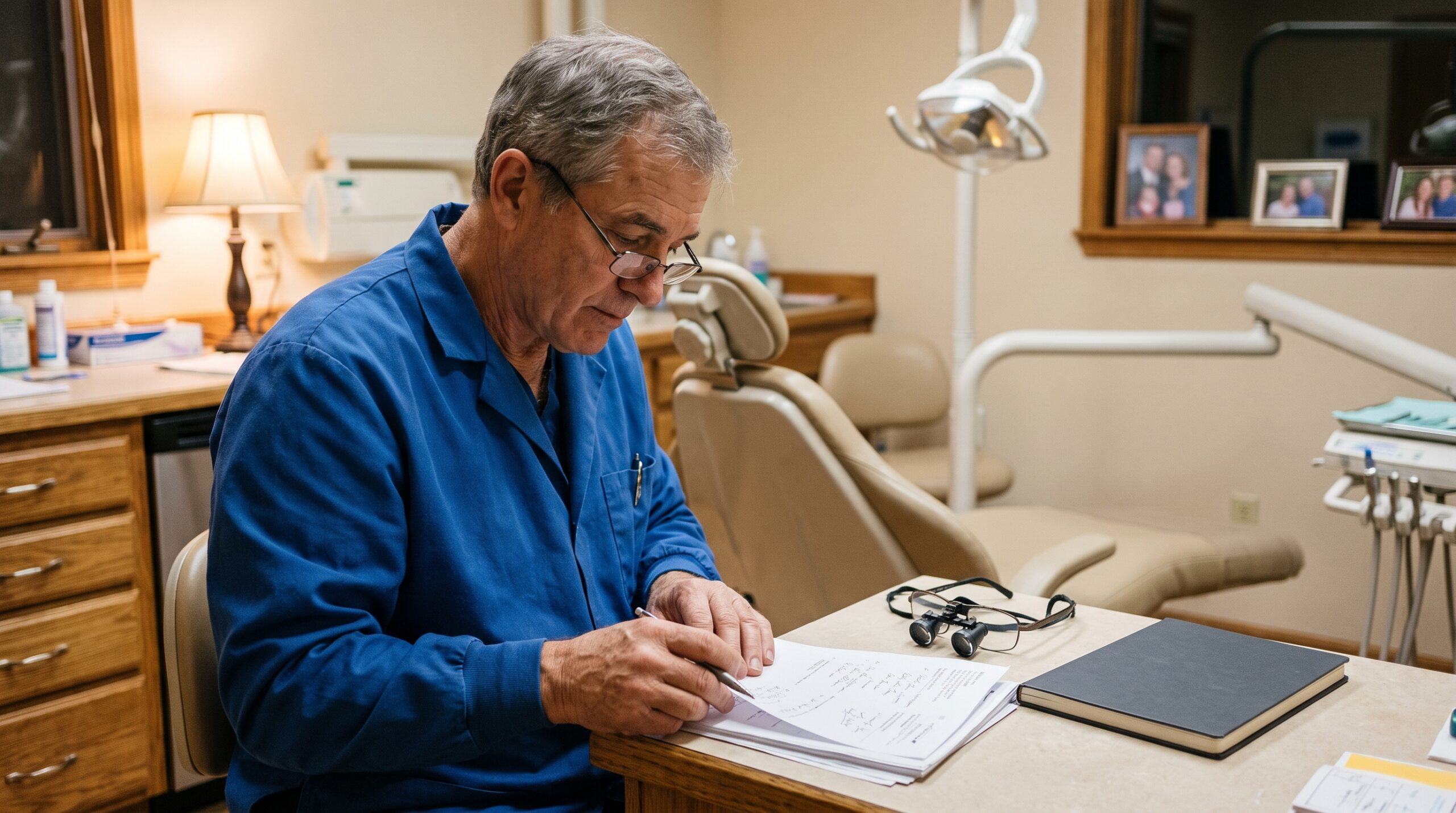
Nobody wants to read this one. I understand that, and I will keep it practical.
A dental practice is probably one of the two largest assets you own. It is also the most fragile one you own, in a way that a rental property or a share portfolio is not, because its value depends on a licensed professional showing up.
Remove that professional without warning and the asset does not simply pass to your family. It starts losing value immediately, and the rate of loss is faster than almost any owner expects.
This article is about what actually happens, and about the small amount of planning that changes the outcome.
Key takeaways
- Your family probably cannot legally own or operate the practice. Most states restrict practice ownership to licensed dentists, with narrow and time-limited exceptions for estates.
- Value decays in weeks, not years. Patients reschedule, staff take other jobs, and production stops. A practice that sat idle for three months is worth a fraction of what it was.
- A forced sale is the worst kind of sale. Everyone at the table knows the seller cannot wait, and the price reflects that.
- Disability is the more likely scenario and the less planned-for one. It creates the same operational problem with none of the finality that triggers an estate process.
- The fix is unglamorous and cheap relative to the exposure: a written contingency plan, a locum arrangement, the right insurance and a current valuation.
What happens to a dental practice when the owner dies? In most states a family member who is not a licensed dentist cannot own or operate the practice, and estate exceptions are typically time-limited. Practical control passes to the estate, which must arrange licensed coverage quickly or sell.
Value declines rapidly because patients, staff and production disperse within weeks.
The legal problem your family will hit first
Most states apply the corporate practice of dentistry doctrine, which restricts ownership and control of a clinical dental practice to licensed dentists.
It is the same body of law that requires dental support organizations to operate through a management services structure rather than owning the clinical entity directly, and it has been receiving increased regulatory attention.
California settled an enforcement action against a large dental support organization in May 2026 over alleged violations, and SB 351 expanded the state’s statutory regulation of these arrangements.
For your family, the practical consequence is narrow and immediate. If your spouse is not a dentist, they generally cannot simply take over your practice.
Most states do provide a limited exception allowing an estate or a non-licensed heir to hold a practice for a defined period, often something in the range of six to twelve months, specifically so it can be sold or transferred in an orderly way.
The details vary considerably by state, and this is one of the places where a short conversation with a healthcare attorney licensed where you practise is genuinely worth the fee.
What that exception means in practice is a clock. Your family will have a window, not an indefinite right, and the window is usually shorter than the time it takes to sell a practice properly.
Why value falls so fast
This is the part owners consistently underestimate, so let me be specific about the mechanism.
Week one. Patients on the schedule need to be seen or rescheduled. Without a licensed dentist, they are rescheduled.
Emergency patients go elsewhere and, having gone elsewhere, frequently stay there.
Weeks two to four. Staff begin to worry, and they are right to. Your hygienists are the most employable people in dentistry right now, with roughly 90% of practices reporting that hiring hygienists is very or extremely challenging.
They will have offers within days of putting the word out. Your front-office team, who hold the relationships and know the systems, are similarly mobile.
Month two. Production has stopped but overhead has not. Rent, equipment finance, insurance and any remaining payroll continue.
The practice is now consuming cash rather than generating it.
Month three onward. Recall lapses. Patients who came every six months miss their appointment and do not rebook.
Referral sources quietly redirect. The patient base, which is the actual asset, disperses.
By month four a buyer is no longer looking at a practice. They are looking at equipment, a lease and a patient list of uncertain quality.
The adjusted EBITDA that would have supported a multiple has become a negative number, and the price collapses accordingly.
Contrast that with a planned sale, which typically runs six to ten months from engagement to close, with the practice fully operating throughout. Same practice.
Radically different outcome.

Disability is the scenario people skip
Death gets some planning. Long-term disability usually gets none, and it is more likely.
The situation is worse in one specific way. Death triggers an estate process, with an executor, legal authority and a defined path.
A stroke or a back injury or a cognitive change triggers nothing automatically. Someone still owns the practice and is unable to run it, and often unable to authorise anyone else to.
If you become incapacitated without a durable power of attorney that specifically covers business decisions, your family may have to petition a court for authority before they can sign a locum agreement, approve payroll or negotiate a sale.
That process takes weeks or months, and the value clock above is running the entire time.
Practices also fail slowly in this scenario in a way that damages them further. An owner working through a serious illness produces less, defers decisions and postpones investment.
By the time a sale happens, the financials show a declining practice, which is the hardest kind to sell well.
What it looks like when there is no plan
I want to walk one through, because the abstract version does not land.
An owner in his early sixties has a stroke on a Tuesday. He survives.
He will not practise again.
Week one. His wife cancels the week’s schedule. She does not have the practice management password.
The office manager does, and handles it well, but nobody knows who is authorised to decide anything.
Week three. Both hygienists have been approached by a group twenty minutes away. One takes the offer.
Nobody blames her. She has a mortgage, and the practice has told her nothing, because nobody has the standing to tell her anything.
Week six. The wife discovers that the general power of attorney signed in 2019 does not clearly extend to business decisions. Her attorney advises a court petition.
That will take a couple of months.
Month three. Rent, equipment finance and insurance have continued throughout. Production has been near zero for eleven weeks.
Recall has lapsed. The associate who might have held things together left in month two, because there was nobody to negotiate with about her future.
Month five. Authority finally arrives. What is being sold now is equipment, a lease and a patient list nobody has contacted in five months.
Two buyers look. Both know exactly what the situation is.
Every step of that was preventable. Not by a larger insurance policy or a more sophisticated estate plan.
By a one-page document naming a locum, a power of attorney with the right sentence in it, and a valuation from two years earlier so the family knew what they were being offered against.
The plan, and it is genuinely short
None of what follows is complicated or expensive relative to the exposure.
One: a written practice contingency plan. A single document, kept somewhere your family can find it, stating who to call first, who your attorney and CPA are, who holds your practice management system credentials, which colleagues have agreed to provide emergency coverage, and what your wishes are regarding a sale. Owners who do only this one thing materially improve their family’s position.
Two: a locum or emergency coverage arrangement. An informal agreement with two or three local dentists that they will cover in an emergency, and that you will do the same. This is what keeps the schedule running through the first critical weeks.
It costs nothing to arrange and it is the single highest-value item on the list.
Three: a durable power of attorney that explicitly covers the practice. General estate documents frequently do not extend clearly to business operations. Have your attorney confirm the language reaches practice decisions specifically.
Four: disability insurance that covers overhead, not just income. Personal disability insurance replaces your income. Business overhead expense insurance covers the practice’s fixed costs while you are unable to work, which is what keeps the doors open and the team employed while a plan is made. Many owners carry the first and not the second.
Five: a current valuation. Your family cannot negotiate what they cannot value. An out-of-date number, or none, means accepting whatever is offered.
Refresh it every couple of years.
Six: buy-sell provisions if you have a partner. Agree now what happens if one of you dies or becomes disabled, how the departing share is valued, and how it will be funded. Life insurance held by the partnership is the usual funding mechanism.
Partnerships without this frequently end up with a surviving partner and a bereaved family on opposite sides of a negotiation, which is a bad situation for everyone.
What your family should actually do
If the worst happens, the priority order is not obvious, so it is worth writing down for them.
Keep the practice open. Coverage first, everything else after.
A practice that keeps seeing patients retains its value; one that closes starts losing it immediately.
Talk to the team early and honestly. They will hear something regardless, and uncertainty is what drives them to take other jobs.
Staff who understand the plan usually stay considerably longer than staff who are guessing.
Get advice from someone who knows practice transactions specifically, not general business brokerage. The regulatory constraints on who may own a dental practice make this a specialised problem.
Do not accept the first offer. Distressed sales attract opportunistic buyers, and a family under pressure is exactly the situation some buyers watch for.
Even under time pressure, having two or three interested parties changes the number materially.
Understand the tax position before signing. How the price is allocated across asset classes determines how much is taxed at capital gains rates rather than ordinary income, and both sides must report it consistently to the IRS on Form 8594.
In an estate context this interacts with basis rules in ways that deserve a CPA’s attention.
Tell your family where the file is
The last piece is almost embarrassingly simple and it is the one most often missed.
A contingency plan that nobody can find does nothing. Tell your spouse, your executor and your office manager where it lives, and make sure at least two of them can access it without you.
Include the practical items: who your attorney and CPA are, which colleagues have agreed to provide coverage, where the practice management credentials are held, which insurer covers overhead, and the date of your most recent valuation.
One page. Reviewed once a year.
It is the highest-value hour of administrative work available to a practice owner, and it takes less time than a single insurance appeal.
The thing worth taking from this
I have sat with families in the middle of this. What separates the ones who came out reasonably from the ones who did not was rarely the size of the practice or the sophistication of the estate plan.
It was whether anyone had written down what to do.
The buyer market is deep and well capitalized. The Association of Dental Support Organizations counts 80-plus member companies, Becker’s tracked more than 200 DSO affiliations in 2025, and 69% of DSOs reported in 2026 that their sponsors expect increased acquisition activity.
Your family will not struggle to find a buyer.
What they will struggle with is finding one before the value goes, without knowing what the practice is worth, while grieving.
They will also be doing it alone, against a single buyer, with no competing bid to measure it against. A planned sale runs the opposite way.
The Elite Selling System exists to put several vetted buyers at the table at once, the way a doorman with a velvet rope lets in only the right people, and that is exactly the leverage a family in this position has no way to build.
An afternoon of preparation now removes most of that. If part of that preparation is knowing your current number, we will give you a free, confidential practice value estimate with no obligation, and you can put it in the file with everything else.
This article is general information about how practice transactions work, not legal, tax or financial advice. The rules governing practice ownership vary by state, and your own arrangements should be reviewed by an attorney and a CPA licensed where you practise.
Frequently asked questions
What happens to my dental practice if I die?
Practical control passes to your estate. In most states a non-licensed family member cannot own or operate the clinical practice, though many states allow an estate to hold it for a limited period so it can be sold or transferred.
Value declines quickly if the practice stops seeing patients.
Can my spouse take over my dental practice if they are not a dentist?
Generally not on a permanent basis. The corporate practice of dentistry doctrine restricts ownership to licensed dentists in most states, with time-limited exceptions for estates.
Rules vary by state and should be checked with a healthcare attorney licensed where you practise.
How quickly does a dental practice lose value if the owner cannot work?
Faster than most owners expect. Patients reschedule within the first week, staff begin leaving within a month, and recall lapses within a quarter.
By around month four a buyer is valuing equipment, a lease and an uncertain patient list rather than a functioning practice.
What is the single most useful thing I can do to protect my family?
Arrange emergency clinical coverage with two or three local dentists and write down a short contingency plan stating who to call and where the key information is. It costs nothing and it is what keeps the practice operating through the critical first weeks.
Does regular disability insurance protect the practice?
Usually only partly. Personal disability insurance replaces your income.
Business overhead expense insurance covers the practice’s fixed costs while you cannot work, which is what keeps the doors open and the team employed. Many owners carry the first without the second.
Why does disability need separate planning from death?
Death triggers an estate process with defined legal authority. Incapacity triggers nothing automatically, so without a durable power of attorney that specifically covers business decisions your family may need a court order before they can act, while the practice loses value in the meantime.
What should my partner and I agree in advance?
What happens if either of you dies or becomes disabled, how the departing share is valued, and how the purchase will be funded, commonly through life insurance held by the partnership. Without this, a surviving partner and a bereaved family end up negotiating at the worst possible time.
How often should I update my practice valuation?
Every couple of years is reasonable, and after any significant change in production, staffing or debt. Your family cannot negotiate a price they have no basis to assess.
Sources
Practice ownership law and regulation
- US House Committee on Oversight. “Survey of State Laws Governing the Corporate Practice of Dentistry.” oversight.house.gov
- Nixon Peabody LLP. “California Attorney General signals increased corporate practice enforcement.” nixonpeabody.com
- Hinshaw & Culbertson LLP. “A New Era of Compliance Standards for California DSOs and MSOs After the Aspen Dental Settlement.” hinshawlaw.com
- Dorsey Health Law. “California Attorney General Escalates Corporate Practice Enforcement in Medical and Dental Care.” dorseyhealthlaw.com
- Benesch. “Dental/DSO Industry Newsletter, May/June 2026.” beneschlaw.com
Transaction process and timelines
- Mandelbaum Barrett PC. “The Four-Phase DSO Transaction Process: What to Expect When Selling a Dental Practice.” mblawfirm.com
- Cranfill Sumner LLP. “Selling Your Dental Practice to a DSO: What to Expect Before, During, and After the Deal.” cshlaw.com
Tax
- Internal Revenue Service. “Instructions for Form 8594, Asset Acquisition Statement.” irs.gov
- Florida Dental Association. “Understanding the Allocation of Assets and Minimizing the Tax Liability in a Practice Sale.” floridadental.org
Workforce and practice economics
- ADA Health Policy Institute. “Dental Hygienist Shortage.” ada.org
- ADA Health Policy Institute. “Trends in Dentists’ Income, Revenue and Hours Worked.” ada.org
- ADA Health Policy Institute. “Dentist Retirements Increase.” ada.org
- ADA Health Policy Institute. “Dental Practice Research.” ada.org
Buyer market
- Association of Dental Support Organizations. “About ADSO.” theadso.org
- Becker’s Dental Review. “200+ DSO affiliations in 2025: State-by-state breakdown.” beckersdental.com
- Becker’s Dental Review. “69% of DSOs plan to boost acquisitions in 2026: Report.” beckersdental.com

Melani Seymour, co-founder of Transitions Elite, helps veterinary practice owners take action now to maximize value and secure their future.
With over 15 years of experience guiding thousands of owners, she knows exactly what it takes to achieve the best outcome.