
Riccobene Associates and Your Dental Practice: What Owners Should Know in 2026
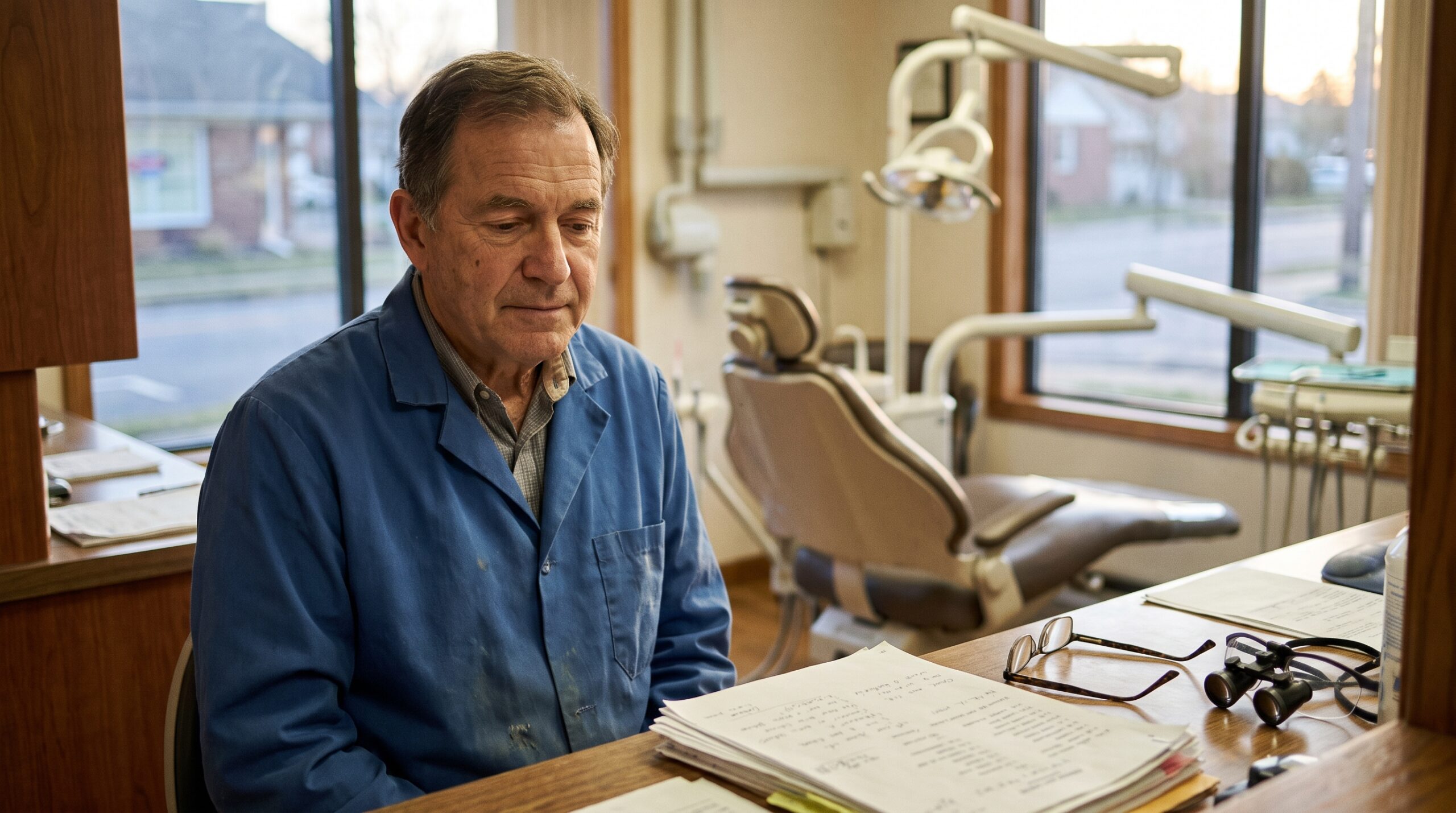
The letter is on the counter by the sterilization bay. You will read it properly tonight.
What you do first, though, is something smaller and stranger. You look at the referral pad by the phone.
Three names on it. The endodontist who has taken your 6pm molar emergencies since 2011.
The oral surgeon who never once made you feel stupid about a root tip. The pediatric dentist your hygienists trust with the difficult four-year-olds.
Nowhere in the letter does anyone mention them. Nowhere on the schedule of assets will they appear either.
And they are, quietly, one of the more consequential things about to change.
Key takeaways
- Riccobene Associates genuinely affiliates existing independent practices. Three separate 2025 partnerships are on the public record, and its footprint has grown from 62 clinics to more than 70 across North Carolina, South Carolina and Virginia.
- It is both founder-led and majority private-equity-owned. Comvest Private Equity took a majority position in November 2024; Dr. Michael Riccobene kept a meaningful stake and remains chief executive. Both facts are true at once.
- General dentistry is the base, specialty is the layer. Every location offers general dentistry; orthodontics, oral surgery, pediatrics, periodontics and endodontics sit at selected sites.
- Your referral network is an unpriced asset. Affiliating with a group that has specialists in-house redirects production you currently send out of the building, and that shift happens after your price is set.
- The same practice is worth different amounts to different buyers. A group that can recapture your referred-out production values it differently than one that cannot. You only discover that by asking more than one.
Does Riccobene Associates buy existing dental practices? Yes. Riccobene affiliates existing independent practices across North Carolina, South Carolina and Virginia, adding three in 2025 alone, and runs a dedicated seller-facing affiliation arm.
Comvest Private Equity took a majority position in November 2024 alongside founder Dr. Michael Riccobene.
Who Riccobene Associates actually is
Founded in 2000 by Dr. Michael Riccobene, starting from a single practice in Selma, North Carolina.
Headquarters are now in Cary.
At the time of its November 2024 recapitalization it supported 62 multi-specialty clinics and more than 150 providers across North Carolina, Virginia and South Carolina. Its own location directory now lists more than 70.
A word on the label. A DSO is a dental support organization: the management company owns the non-clinical side of a practice and handles everything outside the operatory, while a licensed dentist keeps ownership of the clinical entity.
That structure is not a marketing preference. Most states restrict who may own or control a dental practice under the corporate practice of dentistry doctrine, and the DSO model exists to operate inside those rules.
Now the part that trips up owners doing their own research at ten at night.
The name on the letter is not the name on the door. Riccobene’s patient-facing brands are Brush & Floss in the Carolinas and Commonwealth Dentistry in Virginia. The legal entity named in its 2024 sale documents is BAF Management Services, LLC.
The seller-facing arm has a fourth identity again: Riccobene Affiliates, at its own web address, with its own email and phone line.
So an owner who types the brand on the letterhead into a search bar can land on a patient site about cleanings and whitening, conclude there is nothing there, and stop looking. Search the affiliation arm instead.
Who owns Riccobene Associates, and what “doctor owned” means here
The partnership page says, in lower case, “doctor founded. doctor owned.”
That phrase is worth pausing on, because in dentistry it carries more weight than it usually deserves. Here is the verified position.
Comvest Private Equity announced a majority investment on 1 November 2024, made in partnership with Dr. Riccobene, who retained a meaningful stake and continues as chief executive alongside the existing management team.
The Beekman Group, which had held a minority stake since 2018, exited in the same transaction. Holland & Knight advised Riccobene on the sale.
So both statements are accurate. The founder is a real owner and a real operator.
A private equity firm holds the majority.
Owners routinely read “doctor owned” as meaning there is no financial sponsor and therefore no clock. That inference does not follow, and it is worth checking against the sponsor’s own portfolio page rather than the marketing page.
Why it matters to you is practical, not philosophical.
A sponsor-backed platform has a horizon. It will eventually pursue a liquidity event, and the timing of that event is set by the sponsor rather than by the founder or by you.
Say part of your consideration is rollover equity, meaning a slice of ownership in the buyer’s company instead of all cash at close. That horizon is the thing your paper sits and waits on.
None of which is a criticism. Comvest’s own release describes the investment as intended to accelerate the pace of expansion, and a funded buyer is generally a better counterparty than an unfunded one.
You just want to know which kind of counterparty you have.
Does Riccobene buy existing practices, or build new ones?
Both, and the buying is well documented.
That distinction is not academic. Of the three largest DSOs in the country, only Heartland Dental is substantially acquisition-led.
Aspen Dental and PDS Health grow primarily by opening new offices. An owner who assumes every large name is bidding for existing practices is working from a bad map.
Riccobene is on the buying side of that line. Three dated affiliations in 2025:
25 March 2025. Night and Day Dental’s Concord and Independence locations, in the Charlotte market.
24 April 2025. Pfabulous Gentle Dentistry in Chesterfield, Virginia, joining under the Commonwealth Dentistry banner. It is a general and cosmetic practice led by two general dentists.
9 September 2025. Palms Dentistry, with sites in Simpsonville and the Mauldin area of Greenville. That one opened a new market for the group, Upstate South Carolina.
It opens its own offices too. Its founder has grown the organization through de novo additions as well as acquisitions of single practices and groups.
But the seller-facing infrastructure is real and current. There is a partnership page inviting owners to make contact, and a separate affiliation site with its own contact details.
That combination is what an owner should look for before treating any approach seriously. A live seller surface, dated deals, fresh capital behind them.
The asset that never appears on the schedule
Here is the thing almost nobody raises in a first conversation with a buyer.
Every general practice runs a referral economy. Molar endodontics, third molars, surgical implant placement, periodontal surgery, complex orthodontics, the pediatric cases your team would rather not chase.
Some of that work leaves your building. Some of it you keep.
Where you have drawn that line is a decision you made over twenty years, partly on clinical judgment and partly on who you trust.
Two numbers sit behind it, and most owners have never separated them.
What you refer out. Production that is generated in your chair, diagnosed by you, and performed by somebody else. It shows on nobody’s report as revenue.
What you keep in. Procedures you do yourself that a more conservative colleague would send away, which inflate your production per patient relative to peers.
Now introduce a buyer with specialists on staff. Riccobene’s own directory offers general dentistry at every location, with orthodontics, oral surgery, pediatrics, periodontics and endodontics at selected sites, and tells patients a location offering the treatment they need is usually nearby.
Becker’s Dental Review reports the sector broadly moving this way. Groups are adding orthodontics, periodontics and oral surgery so more care sits under one roof.
Which is good for patients, frequently good for the group, and something you should think about carefully before you sign.

The referral arithmetic, walked through
Abstract talk about referral patterns decides nothing. Numbers make it decidable.
Take a practice collecting $2.8 million. Four operatories, two hygienists, one part-time associate.
Overhead runs at 61 percent, which is honest rather than flattering.
First, the bridge dentists rarely do. Collections means the money actually collected, not billed or produced. Take that, subtract true operating overhead, and roughly $1.09 million is left.
Then subtract what it would cost to hire an associate at market rate to do the owner’s own production. Call it $310,000.
What remains is about $780,000 of adjusted EBITDA: the operating profit after paying a market-rate dentist to do the work she currently does herself.
That figure is what a buyer values. Not collections, and certainly not a percentage-of-collections number overheard at a study club.
Now the part the model never captures.
Last year she referred out roughly $210,000 of diagnosed production. Molar endo, thirds, surgical placement, two full-arch cases she sent to a prosthodontist.
None of that $210,000 is in the $780,000. It never touched her books.
And the price she is offered is calculated on the $780,000.
Watch what happens next, in three directions.
The group absorbs it. Its endodontist and oral surgeon start taking that work at their own sites. The production is captured, but in the group’s results, at a location that is not hers.
Her practice looks unchanged.
The group brings it to her. A specialist rents a day a week in her building. Some of that $210,000 now lands inside her four walls.
If she has an earnout, meaning part of the price paid later and only if the practice hits agreed targets after closing, that is the difference between a target she reaches and one she watches from a distance.
The flow reverses. Her chair time gets reorganized around what the group would rather she personally produce, and a slice of what she used to keep in-house goes to a group specialist instead. Her location’s numbers move without her clinical judgment changing at all.
There is no villain in any of those three. It is how integration works, and a well-run group will tell you which one it intends.
The line worth remembering is this. Your historical EBITDA sets the price. Your post-close referral map sets the earnout. They are measured on two different worlds, and only one of them existed when the number was agreed.
Becker’s also reports buyers in 2026 watching provider risk harder, walking away from deals over over-reliance on a single producer, and more often requiring a five-year post-close employment commitment. That is the same underlying question from the buyer’s side of the table.
What happens to the specialists you refer to now
The other half of this is not arithmetic at all.
Those three names on the referral pad are colleagues, and in a lot of cases friends. Some of them built a meaningful share of their own schedule on work you sent.
An affiliation can redirect that flow without anybody intending harm, and without anybody telling them first.
Two things are worth doing.
Tell them yourself, before the announcement. Not the terms. You will be under a confidentiality obligation and should honor it.
Just the fact, at the point it becomes real, from you rather than from a patient.
Get your referral discretion in writing. The ADA frames a specialty referral as a clinical judgment about education, training and experience, and keeps the general dentist responsible for coordinating the patient’s overall care.
Ask plainly whether you retain that discretion when the network alternative is further away, or when the case is one you would only trust to a particular pair of hands. A confident buyer says yes without flinching.
And notice the upside, because it is genuine. If the group already has specialists in your market, referrals can start coming toward you rather than only leaving.
For a practice with capacity in restorative, that is real growth you did not have to buy.
What kind of practice Riccobene looks for
There is no published revenue threshold, patient-volume minimum or geographic screen. Almost no buyer publishes one, and the ones that do move the line anyway.
The footprint tells you more. Three contiguous Southeast states, deep density in North Carolina, expanding market by market into Virginia and South Carolina.
Its partnership page describes designing arrangements around the individual doctor: selling, transitioning, partnering, or opening a new location. Not one fixed structure.
Hygiene percentage matters here as it does everywhere: hygiene production as a share of total collections, read by buyers as a proxy for recurring, transferable patient revenue.
Transferability is the real test. A practice patients attend because it is the practice survives an owner’s departure.
One they attend because of you is harder to underwrite, and buyers price the difference.
What an offer typically contains
Riccobene does not publish a price sheet, and neither does anyone else in this market. What a buyer pays depends on the practice, the market, their appetite, their capital position, and above all on who else is bidding.
Any source quoting you a specific multiple for a named buyer is generalizing from a handful of deals it half-remembers.
What holds broadly across the private-equity-backed pool: cash at close is typically a portion of the headline figure. Rollover equity usually makes up part of the balance.
An earnout may make up the rest.
There is also a post-closing employment agreement, nearly always, with a compensation formula and restrictive covenants that are terms rather than formalities.
One dental-specific wrinkle deserves its own line, and it connects straight back to the section above.
Read the earnout definition for how specialty production is treated. If work performed by a group specialist on a patient you diagnosed counts nowhere in your target, you have accepted an earnout that your own referrals can quietly deflate.

What changes after the sale
Start with what tends not to change, because it is more than owners expect.
Riccobene operates more than one patient-facing banner, and its 2025 announcements emphasize continuity of team and providers at the practices that joined. A group running several brands has less structural need to convert everything to one sign.
Treat that as the starting point of a conversation, not the end of one. Get the specific commitment about your name and your banner written down.
What does change is the back office. Payroll, benefits, insurance contracting, purchasing, marketing, compliance and IT move to a central function.
For many owners that is the entire appeal.
Your team feels it first. New benefits, a new payroll system, new reporting lines for some roles.
Better they hear it from you.
And the reliable way to test any of this is not the pitch deck. It is a phone call with two dentists who affiliated at least two years ago.
Long enough for integration to have happened and the honeymoon to have ended.
Questions worth asking Riccobene specifically
Generic questions get generic answers. These are shaped for this buyer.
“Which of your locations near me have specialists, and in which disciplines?” This determines almost everything about how your referral pattern will change, and it is a factual question with a factual answer.
“Do I keep discretion to refer outside the network when I judge it clinically right, in writing?” Ask for it in the agreement, not in the meeting.
“If a group specialist performs work I diagnose, where does that production count?” The honest answer may be “nowhere in your numbers.” Better to know before the earnout is drafted than after.
“Would you place a specialist in my building, how often, and who carries the operatory cost?” This is the version of the arrangement that helps you most. It is also negotiable.
“Comvest took a majority position in November 2024. What does the acquisition budget look like over the next twelve months?” A polite capacity question, asked after a firm has publicly committed to accelerating expansion.
“Does my practice name stay, and under which of your banners?” Multi-brand makes it likelier. Written makes it certain.
“Can I speak with two doctors who affiliated at least two years ago, and can I name them myself?” Ask for specific people rather than accepting whoever is offered.
“Who is my day-to-day contact, and how many locations do they support?” That answer tells you more about your future Mondays than any org chart.
Ask these of every buyer you speak to. The answers are only comparable if the questions are identical.
How to know whether the offer is competitive
Here is what actually decides your outcome, and it is not whose name is on the letterhead.
A buyer approaching you directly is competing with nobody. Their offer reflects that.
It would be odd if it did not.
The same organization, bidding against three others who also want your practice, behaves differently. Not because the first number was dishonest.
Because the leverage changed.
The pool is deep enough for that to be real. Becker’s Dental Review tracked more than 200 DSO affiliations in 2025, and 69 percent of DSOs reported in 2026 that their sponsors expect increased acquisition activity.
The ADSO alone counts 80-plus member companies. Roughly 30 to 35 organizations acquire independent general practices at meaningful scale.
Most owners have heard of four.
Page-one search results will show you general dentistry trading at 2.5 to 4 times EBITDA. Those are small-practice or revenue-based figures wearing the wrong label.
Credible ranges for a healthy general practice sit nearer 5 to 7 times, with well-run groups and regional platforms higher again.
Now add the point this whole article has been circling.
The same practice is worth measurably different amounts to different buyers, and the referral question is one of the reasons. A group with specialists nearby sees $210,000 of recapturable production in your chart audit.
A buyer without them sees a general practice and nothing more.
Neither is wrong. They are valuing different futures.
But you cannot discover that from one letter, and the buyer who values you most is rarely the one who wrote first.
Creating that comparison is what the Elite Selling System exists to do. We hand-select and vet every buyer who gets to bid on your practice, the way a doorman with a velvet rope lets in only the right people.
Then we run a private competitive window inside that group. The point is not to squeeze anyone.
It is that you cannot know whether a number is good until a second serious buyer has told you what they think it is worth.
What to do next
If a Riccobene approach is sitting on your desk, the first job is not to judge it against your expectations. It is to make it comparable at all.
Document your adjusted EBITDA properly, with the owner-production adjustment done honestly. Separate cash at close from equity and earnout.
Read the employment agreement as carefully as the price.
Then do the thing nobody tells you to do. Pull twelve months of referrals out and total them.
That number is not on your profit and loss statement, and it is one of the most important figures in the negotiation you are about to have.
Riccobene may well be an excellent home. A founder-led group with 25 years of operating history, fresh backing and specialists across three states is a serious counterparty, and plenty of dentists have been happy with exactly that shape of arrangement.
The point is to choose it on the numbers rather than on the warmth of the letter.
We will give you that assessment free and in confidence. That includes the answer that you should wait eighteen months and fix two things first, when that is the honest one.
It starts with a free, confidential practice value estimate.
Our fee varies depending on the value of the practice and is entirely success-based. If we do not get you a result, we do not get paid.
Frequently asked questions
Does Riccobene Associates buy existing dental practices?
Yes. It affiliated three existing independent practices in 2025 alone: Night and Day Dental in the Charlotte market in March, Pfabulous Gentle Dentistry in Chesterfield, Virginia in April, and Palms Dentistry in Upstate South Carolina in September.
It also opens its own locations.
Who owns Riccobene Associates Family Dentistry?
Comvest Private Equity announced a majority investment on 1 November 2024, made in partnership with founder Dr. Michael Riccobene, who retained a meaningful stake and remains chief executive.
The Beekman Group held a minority stake from 2018 and exited in that transaction.
Is Riccobene doctor-owned or private-equity-owned?
Both descriptions are accurate. The founder is a genuine owner and the operating chief executive, and a private equity firm holds the majority position.
In dentistry generally, “doctor-owned” and “doctor-led” are worth verifying against the sponsor’s own disclosures.
Does Riccobene buy general dentistry practices or only specialty ones?
General dentistry is the foundation. Its own location directory offers general dentistry at every site, with orthodontics, oral surgery, pediatric dentistry, periodontics and endodontics available at selected locations.
The practices it affiliated in 2025 were general and family practices.
What happens to my specialist referrals if I affiliate with a group that has specialists in-house?
Typically the flow is redirected toward the group’s own specialists. Whether that helps or costs you depends on how your earnout is defined.
Ask where specialty production performed on patients you diagnose is counted, and get your referral discretion recorded in writing.
What does Riccobene Associates pay for a practice?
There is no published price sheet, and any specific multiple attached to a named buyer is generalized from limited data. What any organization pays depends on the practice, the market, their appetite and, above all, on who else is bidding.
Why is my practice worth different amounts to different buyers?
Because buyers are valuing different futures. A group with specialists in your market can recapture production you currently refer out; a buyer without that capability cannot.
Density, payer mix and geography move the number the same way. A single offer is not a valuation.
Should I accept a direct offer from Riccobene?
Not before other qualified buyers have had the chance to bid. A single offer tells you what one organization will pay when nobody is competing.
It tells you nothing about what your practice is actually worth.
Sources
Riccobene Associates scale, ownership and affiliation activity
- Comvest Private Equity. “Comvest Private Equity Announces Investment in Riccobene Associates Family Dentistry,” 1 November 2024. comvestprivateequity.com
- Businesswire. “Comvest Private Equity Announces Investment in Riccobene Associates Family Dentistry,” 1 November 2024. businesswire.com
- Businesswire. “The Beekman Group Announces the Sale of Riccobene Family Dentistry,” 5 November 2024. businesswire.com
- Holland & Knight. “Holland & Knight Advises Riccobene Associates Family Dentistry in Sale to Comvest Private Equity,” November 2024. hklaw.com
- Group Dentistry Now. “Riccobene Associates Family Dentistry Secures Majority PE Investment to Accelerate Southeast Expansion.” groupdentistrynow.com
- PR Newswire. “Riccobene Associates Family Dentistry Announces Partnership with Night and Day Dental’s Independence and Concord Locations,” 25 March 2025. prnewswire.com
- PR Newswire. “Commonwealth Dentistry Announces Partnership with Pfabulous Gentle Dentistry and Expansion into Chesterfield,” 24 April 2025. prnewswire.com
- PR Newswire. “Riccobene Associates Family Dentistry Expands into Upstate South Carolina with Partnership with Palms Dentistry,” 9 September 2025. prnewswire.com
- Becker’s Dental Review. “Virginia dental group adds new in-state partner.” beckersdental.com
- Riccobene Associates Family Dentistry. “Partnership with Riccobene Associates Family Dentistry.” brushandfloss.com
- Riccobene Affiliates. “About.” brushandflossaffiliates.com
- Riccobene Associates Family Dentistry. “Locations.” brushandfloss.com
Buyer pool, deal activity and market structure
- Becker’s Dental Review. “200+ DSO affiliations in 2025: State-by-state breakdown.” beckersdental.com
- Becker’s Dental Review. “69% of DSOs plan to boost acquisitions in 2026: Report.” beckersdental.com
- Becker’s Dental Review. “How dental M&A is evolving in 2026.” beckersdental.com
- Becker’s Dental Review. “What the 3 largest DSOs have been up to.” beckersdental.com
- Association of Dental Support Organizations. “About ADSO.” theadso.org
Referral practice, deal process and regulation
- American Dental Association. “Specialty Referrals.” ada.org
- Mandelbaum Barrett PC. “The Four-Phase DSO Transaction Process.” mblawfirm.com
- Cranfill Sumner LLP. “Selling Your Dental Practice to a DSO.” cshlaw.com
- US House Committee on Oversight. “Survey of State Laws Governing the Corporate Practice of Dentistry.” oversight.house.gov

Melani Seymour, co-founder of Transitions Elite, helps veterinary practice owners take action now to maximize value and secure their future.
With over 15 years of experience guiding thousands of owners, she knows exactly what it takes to achieve the best outcome.